Best Pour-Over Drippers
A dripper is a cone with holes in it, which makes it the cheapest piece of equipment in pour-over and the one that changes your coffee the least. What it actually decides is how much of the result depends on you. Steep cones with one large hole put flow under your control and punish an uneven pour; flat-bottomed beds and small outlets take that control away and give back consistency. Neither is better in the abstract — they suit different people and different mornings. We compared the drippers most consistently recommended by home brewers on bed geometry, drainage rate, filter availability and cost, material and heat behaviour, and what owners report after living with them for years rather than weeks.
As an Amazon Associate, Cafe & Crema earns from qualifying purchases. This never affects the price you pay. How we make money.
| Rank | Product | Score | Best for | Link |
|---|---|---|---|---|
| #1 | Hario V60 Ceramic Coffee Dripper, Size 02, WhiteTop pick | 9.4 | Anyone who wants pour-over to reward practice, and anyone following published recipes | Check price → |
| #2 | Kalita Wave 185 Stainless Steel DripperMost forgiving | 9.0 | Consistent coffee on a weekday morning without thinking about the pour | Check price → |
| #3 | Chemex Classic Series Pour-Over Glass Coffeemaker, 6-CupBest for batches | 8.6 | Brewing for two or more at once, and anyone who prefers a light, tea-like cup | Check price → |
| #4 | Hario V60 Plastic Coffee Dripper, Size 02, ClearBest value | 8.4 | Learning pour-over, travelling, or spending the savings on a better grinder | Check price → |
| #5 | Bee House Ceramic Coffee Dripper, Jeans BlueNo special filters | 7.8 | People who do not want to order filters online, and drinkers who prefer a fuller cup | Check price → |
#1 · Our PickTop pick
Hario V60 Ceramic Coffee Dripper, Size 02, White
Best for: Anyone who wants pour-over to reward practice, and anyone following published recipes
What we like
- The reference dripper — nearly every published pour-over recipe is written for it
- Single large outlet puts flow entirely under your control, which is what makes technique pay off
- Spiral ribs lift the paper off the wall so the bed drains evenly
- Ceramic holds heat well once preheated, steadying temperature through the brew
- Filters are cheap and stocked almost everywhere
What we don't
- Unforgiving — a careless pour produces a noticeably worse cup than it would in a flat-bottom brewer
- Ceramic must be preheated or it steals heat from the first pour
- Breaks if dropped, and the cone shape makes it awkward to store
- Size 02 is larger than a single small cup really needs
- Requires a gooseneck kettle to be worth owning
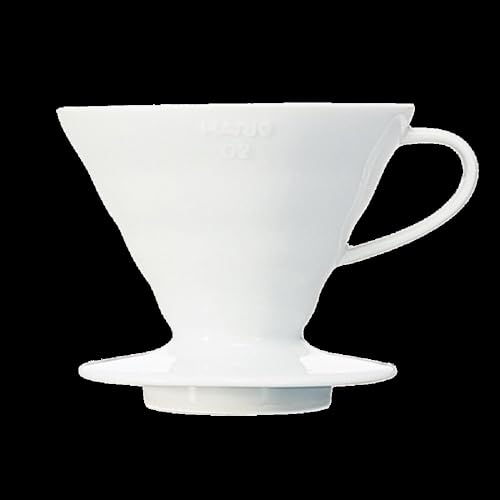
The V60 is the default for a reason that has little to do with marketing: it is the brewer nearly every pour-over recipe you will read was written for. Sixty-degree walls, spiral ribs, and one large hole at the bottom. That combination means the dripper itself restricts flow almost not at all — the grind and the way you pour set the brew time, not the cone. Everything you learn transfers directly into the cup.
That is the whole argument for it and also the whole argument against it. Because the cone does not control flow, a rushed or uneven pour drains fast and produces a thin, sour cup, and there is nothing in the design to save you. Brewers with restricted outlets even out that kind of error; the V60 reports it. If you enjoy the process and want to improve at it, that feedback is the point. If you want coffee while half awake, it is a liability.
The ceramic version is the one to buy if it stays on a counter. It holds heat once preheated, which keeps temperature steadier through a three-minute brew than plastic does, and it feels like an object worth keeping. Preheating is not optional — pour hot water through it before you start, or the first pour goes into a cold cone and the brew runs cool. It also breaks, and the cone shape is genuinely annoying to store. Size 02 covers one to four cups, which is the right size for most households even when brewing a single mug.
One thing to be clear about: a V60 without a [gooseneck kettle](/best-gooseneck-kettles) is not worth owning. The entire design assumes you can place water precisely and slowly, and a normal kettle cannot.
The dripper the rest of the category is measured against. It asks the most of you and gives the most back, which is either the appeal or the problem.
Check price on Amazon →#2Most forgiving
Kalita Wave 185 Stainless Steel Dripper
Best for: Consistent coffee on a weekday morning without thinking about the pour
What we like
- Flat bottom and three small holes produce a level bed that extracts evenly
- Far less sensitive to sloppy pouring than a cone — consistency without technique
- Stainless steel is effectively unbreakable and travels well
- The wave filter's fluted wall keeps the paper off the metal without ribs
- Brews the same way whether you are attentive or not
What we don't
- Wave filters cost more than V60 papers and are harder to find in shops
- Metal loses heat quickly, so preheating matters more than it looks
- Its ceiling is lower — a careful brewer extracts more from a V60
- Three small holes can clog with fines if you grind too fine
- The 185 size is large for a single small cup
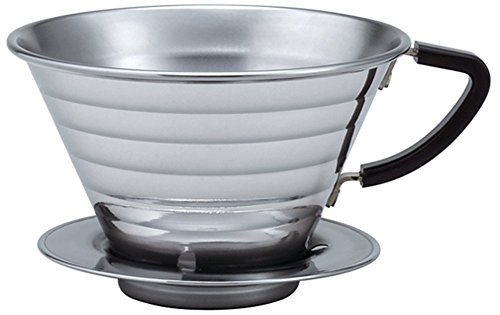
The Kalita Wave answers the V60's main weakness directly. A flat bottom with three small holes and a fluted filter that stands away from the wall means the coffee bed sits level and drains slowly regardless of how neatly you poured. The dripper, not your technique, sets the pace. In practice, the gap between your best brew and your worst narrows sharply, which is the thing most people actually want from a morning routine.
The stainless version is the one worth buying. It cannot break, it survives a bag or a suitcase, and it looks the same after years. It also sheds heat fast, so a preheating rinse matters more than it does with ceramic — skip it and the first minute of the brew runs cooler than intended.
The compromises are filters and ceiling. Wave filters are more expensive than V60 papers and are stocked in far fewer places, which is a real recurring cost and an occasional inconvenience. And the same flow restriction that protects you from a bad pour also caps a good one: an experienced brewer with a gooseneck kettle and a decent grinder will get more out of a V60. If you are not chasing that and want the same cup every day, this is the better buy, and it is the one we would hand to someone starting out.
The dripper that trades peak quality for reliability, and the right first choice for most people. It is much harder to brew a bad cup in this than in a V60.
Check price on Amazon →#3Best for batches
Chemex Classic Series Pour-Over Glass Coffeemaker, 6-Cup
Best for: Brewing for two or more at once, and anyone who prefers a light, tea-like cup
What we like
- Brews and serves in one vessel, which no other dripper here does
- Thick bonded filters remove oils and fines for an unusually clean cup
- One-piece borosilicate glass with no plastic anywhere in the water path
- Genuinely the nicest-looking brewer in the category
- Six-cup size covers a whole household or a slow morning for two
What we don't
- The thick filters slow the brew considerably and need a proper rinse first
- Clean also means thin — it strips body along with the oils
- Awkward to clean, since the neck is narrower than most hands
- Glass, and the wooden collar has to come off before washing
- Filters are expensive and rarely found outside coffee shops and online
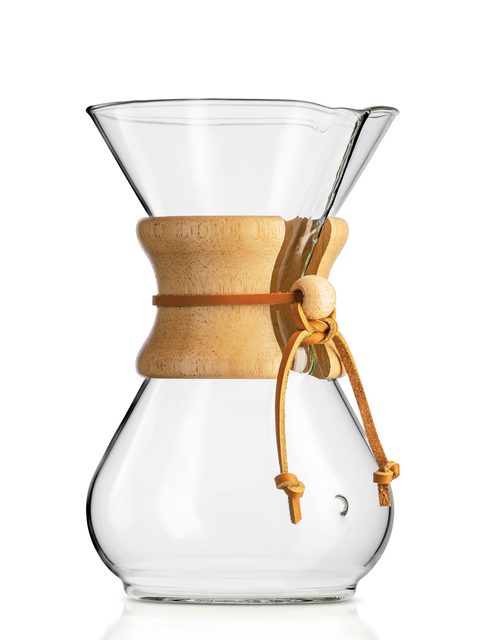
The Chemex is the only brewer here that is also the thing you serve from, which changes what it is for. Where a V60 sits over a mug and makes one cup, a Chemex makes six and holds them, so it suits a household or a long weekend morning rather than a single drinker in a hurry. The one-piece borosilicate design means no plastic touches the water at any point, and the object itself is the reason many people own one.
What defines the cup is the filter. Chemex papers are substantially thicker than ordinary ones, and they trap oils and fine particles that other filters let through. The result is remarkably clean and clear — closer to tea than to what most people picture as coffee. That is genuinely lovely with a bright washed coffee and genuinely disappointing if you like a heavier body, because the same filter that removes the murk also removes the weight.
The practical costs are real. Those thick filters slow drainage, so brews run longer than a V60's and coarser grinds are usually needed. They must be rinsed thoroughly first or the cup tastes of paper. They cost more than standard papers and are much harder to buy locally. Washing the vessel means removing the wooden collar and reaching down a narrow neck. None of that is a reason not to buy one; all of it is worth knowing before you do.
A brewer and a carafe in one object, producing the cleanest cup on this page. The filters are the whole story — both the appeal and the cost.
Check price on Amazon →#4Best value
Hario V60 Plastic Coffee Dripper, Size 02, Clear
Best for: Learning pour-over, travelling, or spending the savings on a better grinder
What we like
- Same geometry and same recipes as the ceramic V60, for a fraction of the price
- Plastic holds heat better than metal and needs less preheating than ceramic
- Effectively unbreakable, and light enough to pack anywhere
- Clear body lets you watch the drawdown, which is genuinely useful while learning
- Cheap enough to own two, or to leave one at the office
What we don't
- Feels disposable next to ceramic or steel
- Plastic stains and picks up odours over years of use
- Scratches easily, and scratched ribs channel water
- No thermal mass, so it will not hold temperature through a long brew
- Same unforgiving flow as the ceramic version, with none of the forgiveness of a Wave
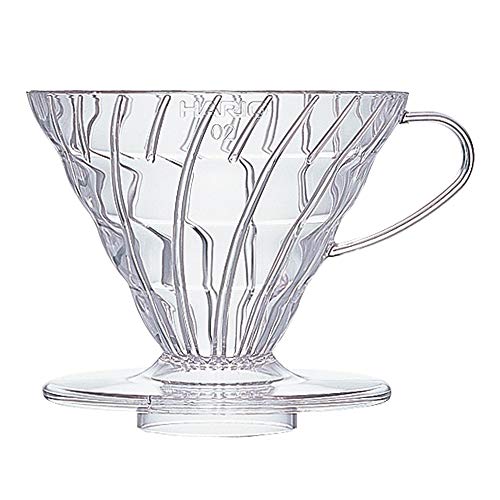
The plastic V60 is the same cone with the same walls, the same spiral ribs and the same single large outlet as the ceramic one, and it brews the same coffee. What it lacks is thermal mass and the feeling of owning something nice. Given how much cheaper it is, that is an easy trade for most people, and it is emphatically the version to buy if the alternative is spending less on your [grinder](/best-coffee-grinders) — which matters far more to the cup than the material of your cone.
It also has one advantage the ceramic lacks: you can see through it. Watching the water level fall during drawdown, and seeing whether the bed is flat when it finishes, teaches you more about your pour than any amount of reading. For learning, clear plastic is the better tool.
What you give up is durability of appearance rather than function. It will not break, but plastic stains, picks up smells from years of coffee oils, and scratches — and scratched ribs are a real problem, because water finds the scratch and channels down it. Replace it when it looks tired, which is affordable precisely because it is cheap. It is still a V60, which means it still demands a careful pour and a gooseneck kettle; it forgives nothing that the ceramic would not.
The most sensible way to buy a V60 if the money is better spent elsewhere. Brews the same coffee as the ceramic; just does not look like it.
Check price on Amazon →#5No special filters
Bee House Ceramic Coffee Dripper, Jeans Blue
Best for: People who do not want to order filters online, and drinkers who prefer a fuller cup
What we like
- Uses ordinary Melitta #2 or #4 filters, sold in every supermarket
- Two small holes restrict flow, so the brew is hard to rush
- Wedge shape and a peek hole let you see the level in the mug below
- Ceramic made in Japan, and it feels considerably better than the price suggests
- Sits stably on a mug without a stand
What we don't
- Restricted flow limits how much you can influence the brew
- Slower drainage than a V60, and it can stall with fine grinds
- Ceramic, so it breaks and needs preheating
- Less-documented brewing — most published recipes assume a V60 or a Wave
- Smaller batch size than the Chemex or the 185
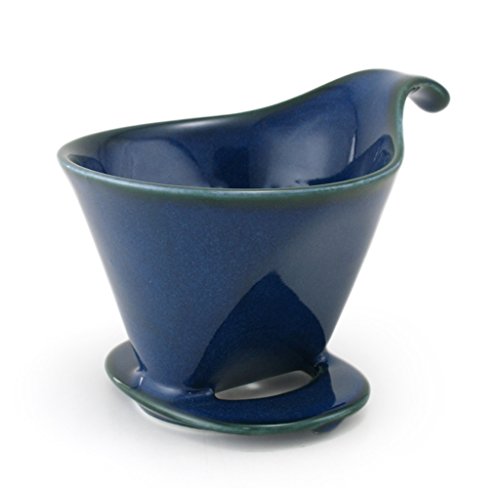
Every other dripper on this page comes with a filter problem. V60 papers are cone-shaped and easy enough to find; wave filters and Chemex papers largely are not, and both cost more than they should. The Bee House sidesteps that entirely by taking the flat-bottomed Melitta #2 or #4 filters that sit on a supermarket shelf next to the coffee. If the reason you have not committed to pour-over is that it means keeping a specialist consumable in stock, this dripper removes that objection completely.
It brews well, in a specific way. Two small holes restrict flow, which means the water spends longer in contact with the coffee and the brew is difficult to rush — the resulting cup is heavier and rounder than a V60's, closer in character to a good drip machine than to a delicate hand pour. The wedge body has a peek hole so you can see the level in the mug beneath, which is more useful than it sounds when brewing directly into an opaque cup. The ceramic is made in Japan and is nicer than its price implies.
The limits follow from the restriction. You cannot speed it up or steer it much, so the range of cups available to you is narrower, and a fine grind can stall it entirely. Very little published brewing advice is written for it, so you are adapting V60 recipes rather than following them. And like any ceramic cone, it needs preheating and it breaks. As a low-friction everyday brewer it is a genuinely good choice; as a brewer to develop technique on, the V60 is the one.
The practical choice when the recurring cost and hassle of specialist filters is the thing putting you off pour-over. Nothing exotic, nothing to source.
Check price on Amazon →Cone or flat bottom is the only decision that matters
Everything else on the spec sheet is secondary to bed geometry. A cone concentrates the coffee into a deep wedge with a large exit, so water accelerates as it converges and the flow is governed almost entirely by your grind and your pour. A flat bottom spreads the coffee into a shallow, even layer over small holes that meter the flow themselves.
The consequence is not that one extracts better. It is that a cone has a higher ceiling and a lower floor, and a flat bottom has a narrower range with both ends closer together. Pick according to whether you want pour-over to be a skill or a routine — and note that nothing stops you owning one of each, since these are the cheapest objects in coffee.
The filter is a recurring cost, and it decides more than you expect
The paper is the part you buy again every month, and it is also the part that shapes the cup most after the coffee itself. Chemex’s thick bonded filters strip oils and fines and produce something unusually clean and light. Standard cone papers let more through and give a fuller cup. Metal filters let almost everything through and give a heavy, sedimented brew closer to a French press.
So check availability and price before committing to a brewer. A dripper whose filters mean an online order every few weeks is one you will use less than you expect, which is the entire argument for the Bee House and its supermarket Melitta papers.
What to spend the money on instead
Drippers are cheap, which makes them a satisfying thing to shop for and a poor place to spend. The order of impact on a pour-over is roughly: the coffee, then the grinder, then your pour and the kettle that enables it, then the dripper. A plastic V60 and a good grinder will beat a ceramic V60 and a bad one, every time and by a wide margin.
If you are assembling the whole setup, pour-over basics covers the ratios and technique the brewers here assume, best gooseneck kettles covers the piece that makes a cone dripper work at all, and best coffee scales covers the one that makes any of it repeatable.
Frequently asked questions
Does the dripper actually change how the coffee tastes?
Less than the grinder, the coffee or your pour, but it is not nothing. What a dripper really controls is how fast water moves through the bed and how level that bed sits, and those set how evenly the coffee extracts. A cone with one large hole lets you brew fast or slow at will; a flat bottom with small holes narrows that range. So the dripper decides the shape of what is possible, and everything else decides where inside that shape you land.
Do I need a gooseneck kettle for pour-over?
For a cone dripper, effectively yes. The whole design assumes you can place a thin, controlled stream exactly where you want it and stop on demand, and an ordinary kettle pours in a wide gush that digs holes in the bed and splashes grounds up the paper. Flat-bottomed brewers with restricted outlets are considerably more tolerant, so if you are trying to avoid buying a kettle, that is the way to do it.
Why do people rinse the paper filter first?
Two reasons, and both are worth the ten seconds. Paper straight from the box tastes of paper, and enough of that carries into a delicately brewed cup to be noticeable — thick filters like Chemex's are the worst offenders. The rinse also preheats the dripper and the vessel below it, which stops the first pour losing several degrees to cold ceramic or metal. Rinse with hot water, tip the water out, then add coffee.
Ceramic, plastic or metal — does the material matter?
Only for heat and durability. Ceramic has the most thermal mass, so once preheated it holds temperature best through a long brew, and it breaks. Metal is indestructible and travels well but loses heat fastest, making the preheat rinse more important. Plastic weighs nothing, cannot break, holds heat better than metal, and looks cheap because it is. The coffee does not know which one you used.
What grind should I use for pour-over?
Medium, around the texture of table salt, as a starting point — then let the brew time correct you. If the water drains through in well under two and a half minutes for a single cup, the grind is too coarse and the cup will taste thin and sour; if it stalls past four, it is too fine and will taste bitter and dry. Restrictive brewers like the Chemex and the Bee House generally want a coarser grind than a V60 for the same time.
Which dripper is best for a beginner?
A flat-bottomed one, in most cases. The Kalita Wave in particular produces a good cup whether or not your pour is even, which means your early brews are drinkable while you learn — and drinkable early brews are what keep people brewing. The counter-argument is that a V60 teaches faster precisely because it shows every mistake. Choose the Wave if you want coffee now, the V60 if you want the hobby.