Best Coffee Scales
A coffee scale is the cheapest way to make your coffee repeatable, and repeatability is most of what separates a good home brewer from an inconsistent one. Scoops measure volume, and coffee's volume changes with grind size, roast level and how the beans settle — so the same scoop delivers a different dose every morning without telling you. A scale removes that. What separates the scales below is not accuracy, which is essentially solved at this price, but responsiveness, water resistance and whether the timer works the way you brew. We compared them on resolution and settling speed, timer and flow-rate behaviour, protection against the spills that kill scales, and long-term owner reports on the failure that actually ends their lives — water reaching the electronics.
As an Amazon Associate, Cafe & Crema earns from qualifying purchases. This never affects the price you pay. How we make money.
| Rank | Product | Score | Best for | Link |
|---|---|---|---|---|
| #1 | TIMEMORE Black Mirror Basic 2 Coffee Scale with TimerTop pick | 9.2 | Pour-over brewers who want the scale to keep up with the pour rather than lag behind it | Check price → |
| #2 | Hario V60 Drip Coffee Scale and Timer, BlackBest simple choice | 8.8 | Anyone who wants a scale and a timer with no features, settings or learning | Check price → |
| #3 | Brewista Smart Scale II for Espresso and Kitchen, 2000 gramsBest for espresso | 8.4 | Espresso, where the scale has to live under a portafilter and start on its own | Check price → |
| #4 | Hario V60 Metal Drip Scale, SilverMost durable | 8.0 | A scale that lives permanently on a counter and needs to look and feel decent | Check price → |
| #5 | OXO Good Grips Digital Glass Food Scale with Pull-Out DisplayCheapest usable | 6.8 | Brewing filter coffee on the smallest budget, or a kitchen scale that can also do coffee | Check price → |
#1 · Our PickTop pick
TIMEMORE Black Mirror Basic 2 Coffee Scale with Timer
Best for: Pour-over brewers who want the scale to keep up with the pour rather than lag behind it
What we like
- 0.1g resolution to 2kg, with a fast, stable response that keeps up with pouring
- Flow-rate display shows grams per second live, which is genuinely useful for pacing a pour
- Timer starts automatically when it detects weight, so the brew begins without a button
- Removable silicone cover protects the surface from the inevitable spill
- Rechargeable rather than a battery-eater, and slim enough to fit under a dripper and mug
What we don't
- The auto-start timer occasionally triggers when you did not want it to
- Flow rate is a feature most people will read once and then ignore
- The silicone cover traps grounds and water underneath if you do not lift it
- Not fully waterproof despite the cover — a real spill still reaches the electronics
- Timemore's support presence is thin outside specialist retailers
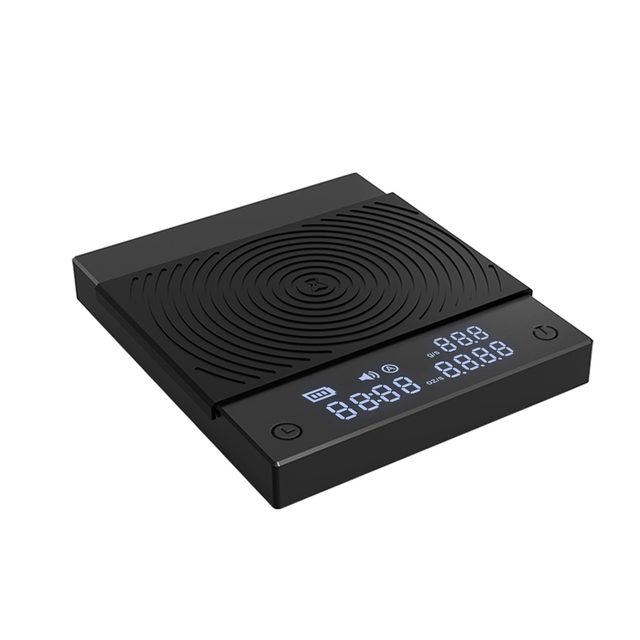
The specification that matters in a coffee scale is not how accurate it is — every scale here is accurate to a tenth of a gram — but how quickly it settles. A scale that lags half a second behind your pour is a scale you overshoot on, which means you stop at 340g when you wanted 330g and your ratio moved without your consent. The Black Mirror Basic 2 responds fast and holds steady, and that single quality is why it sits at the top of this page.
The rest is well judged. The timer starts on its own when weight appears, so the brew begins the moment the first water lands rather than when you remember to press something. The flow-rate readout shows grams per second as you pour, which is a better teaching tool than it sounds: most people pour considerably faster than they think, and seeing the number is what fixes it. The silicone cover takes the spills, and the body is slim enough to sit under a dripper and mug without making the whole stack precarious.
The irritations are minor and worth knowing. Auto-start sometimes triggers when you rest something on the platform, which means an occasional stray timer. The cover traps grounds and water underneath unless you lift it off now and then. And despite the cover it is not waterproof — a genuine spill, as opposed to a splash, still gets in. Treat it like the electronic device it is and it will outlast several kettles.
The scale that gets the important part right: it responds fast enough to pour against. Everything else it does is a bonus.
Check price on Amazon →#2Best simple choice
Hario V60 Drip Coffee Scale and Timer, Black
Best for: Anyone who wants a scale and a timer with no features, settings or learning
What we like
- 0.1g resolution with an uncluttered display that shows weight and time together
- Two buttons and nothing to learn — it does one thing and does it immediately
- Sized to sit under a V60 and a mug without overhang
- Hario is long-established, so parts and replacements are easy to find
- The manual timer never starts when you did not ask it to
What we don't
- Settles more slowly than the Timemore, so overshooting a target is easier
- No flow-rate readout
- No cover, and the surface is not protected against spills
- Timer must be started by hand every brew
- Plainer and less pleasant to use than the price suggests
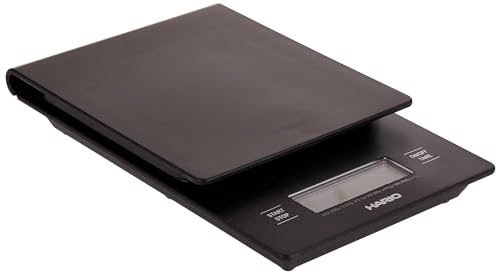
Hario's drip scale is the one that turns up on more home counters than any other, and its appeal is entirely that it does not try. Weight on the left, time on the right, two buttons, 0.1g resolution to 2kg. You press start when you begin pouring and you read two numbers. For a great many people that is the whole requirement, and every additional feature on a competing scale is something else to accidentally trigger at seven in the morning.
It is sized correctly, which is less common than it should be — a V60 and a mug sit on it without overhanging, so the stack is stable and you can see the display while you pour. Hario has been making it long enough that it is easy to buy, easy to replace and well understood.
Where it loses to the top pick is response time. It settles noticeably more slowly, and the practical consequence is that you stop pouring later than you meant to and land past your target weight. That is a small error but a recurring one, and it is exactly the kind of drift a scale is meant to eliminate. It also has no protection against water, which matters in a device that spends its life directly beneath a stream of it. Buy it for the simplicity; buy the Timemore if you want the scale to keep pace with you.
The dependable default. Slower to settle than the top pick, but there is nothing to configure and nothing to go wrong.
Check price on Amazon →#3Best for espresso
Brewista Smart Scale II for Espresso and Kitchen, 2000 grams
Best for: Espresso, where the scale has to live under a portafilter and start on its own
What we like
- Auto-tare and auto-start modes built specifically for pulling shots
- Fast response, which matters more under a portafilter than anywhere else
- Water-resistant silicone cover designed for the wettest place in a coffee setup
- Slim enough to fit on most drip trays, which many scales are not
- USB rechargeable, and the charge lasts through weeks of daily use
What we don't
- Multiple modes mean it is the least obvious scale here to pick up and use
- Fitting on a drip tray depends on the machine — check before buying
- Costs more than the simpler pour-over scales without brewing better coffee
- Owner reports of buttons becoming unresponsive over time
- Overkill if you only brew filter
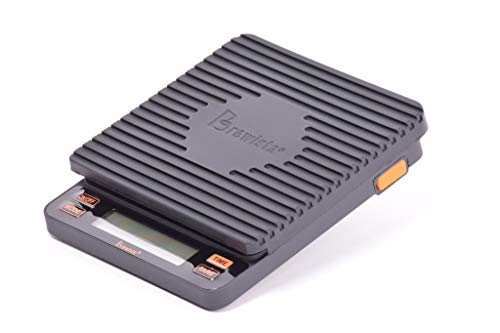
Espresso asks something different from a scale than pour-over does. It has to be slim enough to sit on a drip tray under a portafilter, it has to survive being directly beneath the wettest part of a coffee setup, and it has to start timing on its own — because your hands are busy and a shot that you time from memory is a shot you have not really measured. The Smart Scale II is built around those three requirements.
Auto-tare and auto-start do the useful thing: put a cup on, it zeroes; the first drops land, it starts counting. What you get back is the pair of numbers that actually describe a shot — yield and time — without touching anything mid-pull. Response is fast, which matters here more than in filter brewing because a shot's last few grams arrive quickly. The silicone cover is a serious one rather than decoration.
The caveats are fit and complexity. Slim is relative, and whether it sits on your drip tray depends on your machine — check the height before ordering. The multiple modes mean it is the least immediately obvious scale here, and there is a period of pressing the wrong thing before it becomes automatic. Some owners report buttons becoming unresponsive after long use. And if you only brew filter, you are paying for espresso features you will never enable; the Timemore above does the pour-over job better for less. If you are dialling in shots, [the espresso dial-in process](/espresso-dial-in-grind-dose-yield) is built on exactly the two numbers this scale is designed to capture.
The scale built for the hardest place to put one. If you are dialling in shots, the espresso modes justify the price; if you are not, they do not.
Check price on Amazon →#4Most durable
Hario V60 Metal Drip Scale, Silver
Best for: A scale that lives permanently on a counter and needs to look and feel decent
What we like
- Metal body rather than plastic, and it feels it
- Same 0.1g resolution and integrated timer as the standard Hario scale
- Wipes clean easily, with no textured plastic for grounds to lodge in
- Heavier, so it stays put on a counter instead of sliding
- Looks considerably better than most coffee scales, which are uniformly ugly
What we don't
- Costs more than the plastic Hario without weighing any more accurately
- Metal surface is still not water-resistant where it matters, at the seams
- Same slower settling behaviour as the standard Hario
- Heavier to move and to travel with
- No cover, no flow rate, no auto-start
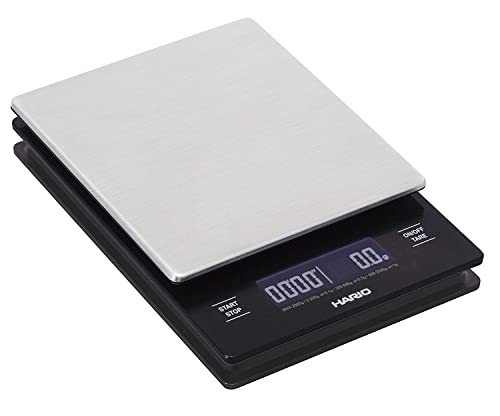
This is the Hario drip scale with a metal body, and it is worth being clear that the extra money buys durability and appearance rather than performance. Resolution is the same 0.1g, the timer works the same way, and the settling behaviour is the same — which means it shares the standard Hario's tendency to catch up with your pour slightly after you have finished it.
What it does buy is a scale that survives kitchen life better. There is no textured plastic for grounds to work into, so it wipes clean in one pass. It is heavy enough to stay where you put it rather than sliding when you set a dripper down. And it is one of the very few scales in this category that looks like it belongs on a counter rather than in a drawer, which is a legitimate consideration for something you use daily and never put away.
The honest caveat is that metal is not the same as sealed. Water still finds the seams and the button surrounds, and a scale killed by a spill is killed regardless of what its shell is made of. If durability is the actual goal rather than appearance, a covered scale like the Timemore protects the vulnerable part better than a metal body does. Buy this one because you want it on your counter.
The same scale as the plastic Hario in a better shell. Buy it for the object, not for the measurements.
Check price on Amazon →#5Cheapest usable
OXO Good Grips Digital Glass Food Scale with Pull-Out Display
Best for: Brewing filter coffee on the smallest budget, or a kitchen scale that can also do coffee
What we like
- Costs less than any dedicated coffee scale and is useful all over the kitchen
- Pull-out display stays readable under a wide dripper or a large bowl
- 11 lb capacity handles anything, including a full Chemex
- Glass top wipes clean instantly
- OXO's warranty is the best in this group
What we don't
- 1g increments, which is not enough resolution for espresso and marginal for coffee generally
- No timer at all, so you need a phone or a separate one
- Slow to settle, so pouring against it is guesswork
- Large footprint compared with a purpose-built coffee scale
- Not designed for water anywhere near it
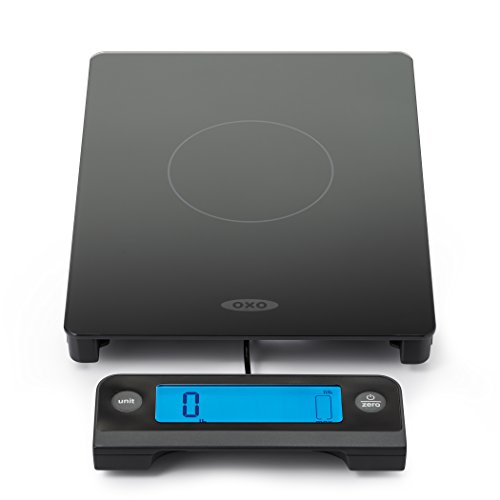
There is a legitimate case for buying this instead of a coffee scale, and it is the same case as buying a cheap burr grinder: the important line is between measuring and not measuring, and everything after that is refinement. If you currently dose with a scoop, weighing to the nearest gram is a large improvement, and this does that while also being the scale you use for baking.
The pull-out display is a genuinely good piece of design and the reason this scale works for coffee at all. Wide drippers and large vessels obscure the readout on most flat scales; pulling the display out from under the platform solves that completely. The glass top wipes clean, the capacity is far more than coffee needs, and OXO's warranty is the strongest here.
The limits are real and you will meet them. One-gram increments are too coarse for espresso, where a gram is a meaningful proportion of the dose, and marginal for filter — you can weigh 18g of coffee but you cannot tell 18.0 from 18.9. It settles slowly, so pouring water against it is approximate rather than measured. And there is no timer, so brew time becomes a phone on the counter. Start here if the budget demands it, and understand that the dedicated scales above solve problems you have not met yet.
A kitchen scale that will get you started, with limits that become obvious quickly. It is a step up from a scoop and a step below every scale above it.
Check price on Amazon →Response time is the specification nobody publishes
Every scale on this page is accurate. What separates them is how fast the number settles, and that is what you actually experience while brewing. Pour water onto a slow scale and the display trails your stream by a fraction of a second, so you stop when it reads 300g and the final number climbs to 310g. Do that every morning and your ratio has quietly moved by three percent — the exact kind of unnoticed drift that weighing was supposed to eliminate.
Nobody prints a settling time on a box, so it is a matter of owner reports and, if you get the chance, watching one work. It is the single strongest reason to choose one scale over another at this price.
Weigh the water, not just the coffee
The most common half-measure in home brewing is a carefully weighed 18g dose followed by water poured by eye until it looks about right. That leaves the ratio — the thing that actually sets strength and extraction — unmeasured, and it is why brews from an accurately dosed setup can still vary from day to day.
Put the whole thing on the scale, tare it after the coffee goes in, and pour to a number. Water weighs a gram per millilitre closely enough that grams and millilitres are interchangeable, so a 1:16 brew from 20g of coffee means stopping at 320g. That is the whole technique, and it costs nothing.
Where a scale sits in the order of spending
A scale is the cheapest meaningful upgrade in coffee and usually the last one people buy, which is backwards. It does not improve a single brew on its own — it makes every brew after it repeatable, which is what turns an occasional good cup into a routine one. Buy it before the nicer dripper and before the second brewer.
Pour-over basics covers the ratios these numbers are in service of, best gooseneck kettles covers the other half of pouring accurately, and best pour-over drippers covers the brewer the whole stack sits under.
Frequently asked questions
Do I really need a scale to make good coffee?
You need one to make the same coffee twice, which amounts to the same thing over time. Volume measurement is unreliable because ground coffee's density changes with grind size, roast level and how it settles — the same scoop can vary by several grams, which is enough to move a brew from balanced to sour. A scale turns your recipe into two numbers you can repeat, and more importantly it means that when a brew goes wrong you know it was not the dose.
Is 0.1g resolution necessary, or is 1g enough?
For filter coffee, 1g is workable — a gram on an 18g dose is about five percent, which is noticeable but not ruinous. For espresso it is not enough, because the same gram is a larger share of a smaller dose and because yield is measured to the tenth. Since 0.1g scales are barely more expensive, buy the finer resolution and stop thinking about it.
What kills coffee scales?
Water, almost every time. These scales spend their lives directly under a stream of hot water or on an espresso drip tray, and once liquid reaches the load cell or the board they either read erratically or stop. A removable silicone cover is the single most effective protection, and no scale at this price is genuinely waterproof no matter what the listing claims. Wipe spills immediately rather than letting them sit in the seams.
Should the timer start automatically?
It is the one convenience feature worth paying for, because it removes a button press from a moment when your hands are busy and wet — and in espresso, where the shot starts whether you were ready or not, it is close to essential. The cost is occasional false starts when you rest something on the platform. If that would bother you more than pressing a button does, buy a scale with a manual timer and lose nothing else.
Can I use a kitchen scale instead?
Yes, with two caveats that decide whether it is a stopgap or a solution. Most kitchen scales weigh in 1g increments, which is fine for filter and not enough for espresso. And most have no timer, so brew time moves to your phone — workable, but one more thing to manage mid-pour. If you already own one, start with it; the improvement over a scoop is much larger than the improvement a dedicated scale would add on top.
What should I weigh — just the coffee, or the water too?
Both, and weighing the water is the half people skip. Dosing the coffee accurately while pouring water by eye leaves your ratio just as uncertain as it was before, since the ratio is what determines strength and extraction. Put the whole brewer on the scale, tare it, and pour to a target weight. Water weighs almost exactly one gram per millilitre, so a 300g target and a 300ml target are the same thing.