Best Gooseneck Kettles
A gooseneck kettle does two things an ordinary kettle cannot: it lets you place water exactly where you want it, and — if it has temperature control — it lets you brew at the same temperature every time. The first is what makes cone drippers work at all. The second is a real but smaller improvement, and it is where most of the price difference in this category lives. Below, the spout matters more than the electronics, and the electronics matter more than the brand. We compared the kettles most consistently recommended by home brewers on pour control and flow rate, temperature accuracy and hold behaviour, capacity and balance when full, and long-term owner reports on the parts that fail — lids, seals, base contacts and controllers.
As an Amazon Associate, Cafe & Crema earns from qualifying purchases. This never affects the price you pay. How we make money.
| Rank | Product | Score | Best for | Link |
|---|---|---|---|---|
| #1 | Fellow Stagg EKG Electric Gooseneck KettleTop pick | 9.4 | Daily pour-over where the kettle is part of the routine rather than a utility | Check price → |
| #2 | OXO Brew Gooseneck Electric Kettle, 1LBest value | 9.0 | Everyone who wants nearly all of the top pick's capability for meaningfully less money | Check price → |
| #3 | COSORI Gooseneck Electric Kettle, 0.8LBest budget | 8.4 | Getting temperature control and a real gooseneck spout on a tight budget | Check price → |
| #4 | Bonavita 1.0L Electric Kettle with Gooseneck SpoutSimplest option | 8.0 | Brewers who want a superb spout and consider temperature control unnecessary | Check price → |
| #5 | Hario V60 Buono Stovetop Gooseneck Kettle, 1.2LBest non-electric | 7.6 | Camping, small kitchens without a spare socket, and anyone who already owns a thermometer | Check price → |
#1 · Our PickTop pick
Fellow Stagg EKG Electric Gooseneck Kettle
Best for: Daily pour-over where the kettle is part of the routine rather than a utility
What we like
- The best pour control here — the spout starts and stops cleanly with no dribble
- Temperature set to the degree, held accurately, with a 60-minute hold mode
- Counterbalanced handle makes slow pouring genuinely steady rather than an arm exercise
- Built-in stopwatch removes the need for a separate timer for bloom and pours
- Feels and looks like a considered object, which matters for something left on a counter
What we don't
- Substantially more expensive than kettles that pour nearly as well
- 0.9 litres is small — one or two brews, then refill
- The base has a real counter footprint for a kettle this size
- Overkill if you brew with a flat-bottom dripper that tolerates a rough pour
- Fellow's support network is thinner than the big kitchen brands'
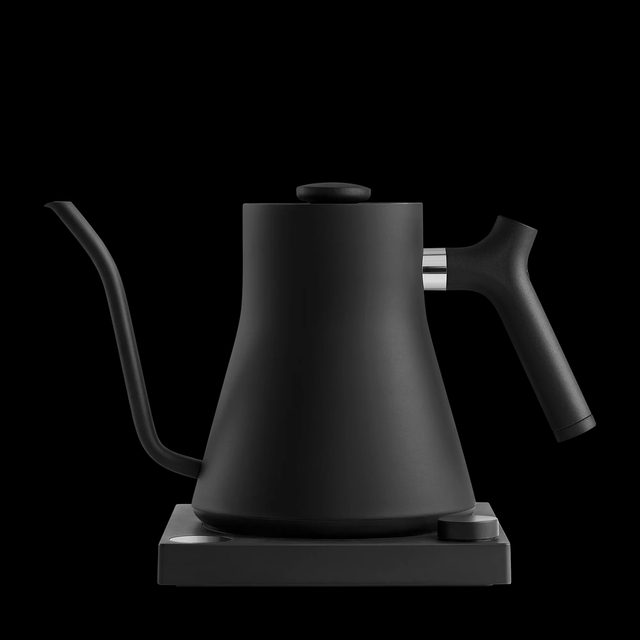
Most of what separates gooseneck kettles is the spout, and this is the best one. The Stagg's flow starts instantly, holds a thin steady stream at almost any tilt, and — the part that is hard to appreciate until you have used a kettle that gets it wrong — stops cleanly without a dribble down the outside. Combined with a counterbalanced handle that puts the weight behind your hand rather than out in front of it, slow pouring stops being something you concentrate on and becomes something you just do.
The electronics are good and are also where the money goes. You set a target to the degree, it gets there and holds it, and a 60-minute hold mode means the kettle is still at brewing temperature when you come back from grinding. The built-in stopwatch is a small thing that removes a separate timer from the counter. None of this changes the coffee as much as the spout does, but it removes the last excuse for inconsistency.
The reservations are price and size. It costs meaningfully more than kettles that pour nearly as well, and 0.9 litres covers one or two brews before a refill, which is limiting if you are making coffee for several people. The base takes up more counter than the kettle's footprint suggests. And if you brew in a [flat-bottomed dripper](/best-pour-over-drippers) that meters flow for you, much of what this kettle is good at is wasted. Buy it because you pour into a cone every morning and want that pour to be effortless, not because it is the most expensive option.
The kettle everything else in the category is compared against, and it earns it on the spout alone. The temperature control is the part you are paying extra for.
Check price on Amazon →#2Best value
OXO Brew Gooseneck Electric Kettle, 1L
Best for: Everyone who wants nearly all of the top pick's capability for meaningfully less money
What we like
- Temperature adjustable in single-degree increments from 104°F to 212°F
- Holds the set temperature for 30 minutes, which covers a whole brew and then some
- Built-in brew timer, so no separate stopwatch is needed
- A full litre — one more brew per fill than the smaller kettles here
- OXO's warranty and service record is among the best in kitchen goods
What we don't
- Spout is good rather than great; the flow is slightly harder to keep thin at low tilt
- Handle is not counterbalanced, so a full kettle takes more effort to pour slowly
- Hold expires after 30 minutes rather than an hour
- Larger and less elegant than the Stagg on a counter
- The digital interface is less pleasant to use than a physical dial
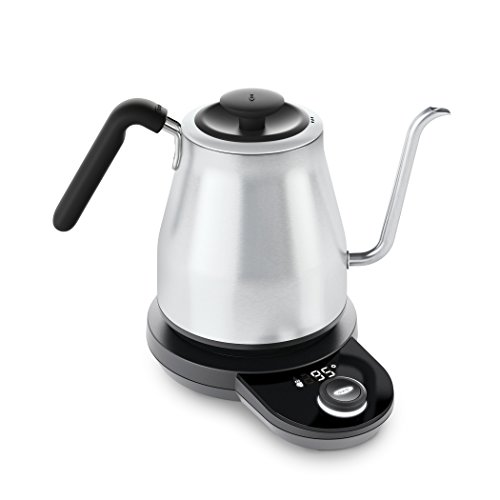
This is the kettle to buy unless you have a specific reason to buy the Stagg. It has the same core capabilities — single-degree temperature setting across the entire useful range, a hold function, a built-in brew timer — and it holds a full litre, which is one more brew per fill than the 0.9-litre kettles above and below it. For most households that capacity difference is more useful day to day than anything the more expensive kettle offers.
Where it is beaten is the pour, and the gap is real if smaller than the price difference suggests. The spout delivers a controllable stream, but keeping it thin at a low tilt takes more attention, and because the handle is not counterbalanced a full kettle wants to tip faster than you intend. That matters most in the first pour of a brew, when the kettle is heaviest and the bloom needs the least water. As it empties, the difference largely disappears.
The other trade is the hold window: 30 minutes rather than an hour. In practice that covers grinding, brewing and a second cup, so it rarely bites. OXO's warranty and customer service are genuinely better than the category norm, which is worth something on an appliance with a controller in it. If you are equipping a pour-over setup and deciding where the money goes, buy this and put the difference into the [grinder](/best-coffee-grinders).
The sensible purchase in this category. It does the same job as the Stagg with slightly less finesse and considerably less money.
Check price on Amazon →#3Best budget
COSORI Gooseneck Electric Kettle, 0.8L
Best for: Getting temperature control and a real gooseneck spout on a tight budget
What we like
- Costs a fraction of the kettles above while still offering temperature control
- Five presets cover the useful brewing range without menu-hunting
- Keep-warm holds temperature for up to 60 minutes
- Interior, lid and spout are stainless steel, so nothing plastic touches the water
- Heats quickly at 1200W for a kettle this size
What we don't
- Presets rather than to-the-degree setting, so you take the temperatures it offers
- 0.8 litres is the smallest capacity here
- Spout control is adequate but clearly a step below the two kettles above
- Owner reports of controller and base failures are more common than for OXO
- The lid is fiddlier to seat than it should be
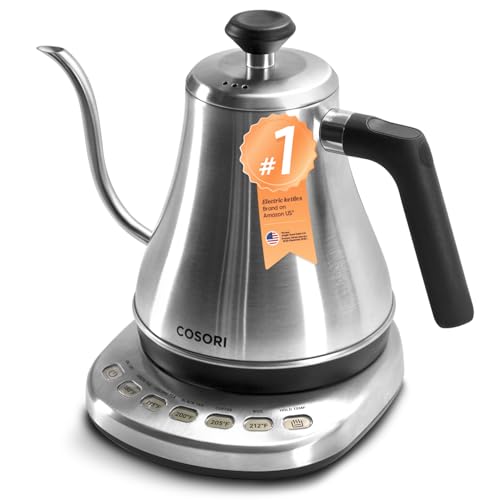
The useful question at this price is whether a cheap gooseneck kettle is a compromise or a false economy, and this one is a compromise in the good sense: it does both of the things the category exists for, just less finely. The spout is a genuine gooseneck that produces a controllable stream — not as easy to keep thin as the Stagg's, but far closer to it than to an ordinary kettle. And it has temperature control, which is the feature people most often assume they have to give up at this price.
What you give up instead is precision and capacity. Five presets rather than single-degree setting means you brew at the temperatures Cosori chose, which is fine for most coffee and frustrating if you are chasing a particular light roast. The 60-minute keep-warm is generous — longer than the OXO's — and covers a slow morning easily. Nothing plastic touches the water, which is not a given at this price.
The real caution is longevity. Owner reports of controllers failing and bases losing contact appear more often for this kettle than for OXO's, and there is less warranty support behind it when they do. Treat it as a kettle that is excellent value now and may need replacing sooner, which at this price is a reasonable bet — particularly if you are still deciding whether pour-over is going to stick.
The cheapest kettle here that still does both jobs properly. Presets instead of precision, and a spout that works without impressing.
Check price on Amazon →#4Simplest option
Bonavita 1.0L Electric Kettle with Gooseneck Spout
Best for: Brewers who want a superb spout and consider temperature control unnecessary
What we like
- Long, narrow gooseneck that pours as precisely as kettles costing far more
- One switch and nothing to configure — boil, wait, pour
- A full litre, enough for several brews or a Chemex batch
- Nothing electronic to fail beyond the element and the switch
- Cheaper than the temperature-controlled kettles while pouring better than most of them
What we don't
- Boils only — no temperature setting and no hold
- You need a thermometer or a wait-and-guess routine to hit a target
- No timer, so a separate one is required
- Boiling and cooling wastes several minutes every morning
- Plain looking next to the kettles above
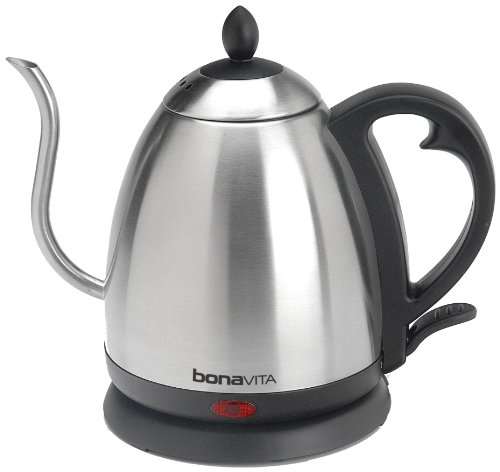
Strip a gooseneck kettle back to the thing it exists for and this is what remains: a long, narrow spout that lets you place water precisely, attached to a heating element and a switch. The pour is genuinely excellent — better than the Cosori's and close to the OXO's — and there is nothing in it to develop a fault beyond the element itself.
What it does not do is manage temperature. It boils, and then you wait. The conventional approach is to boil, leave the lid open for thirty to sixty seconds, and pour at roughly the right point, or to use a thermometer if you want to know rather than assume. That is a workable routine and it is what everyone brewing pour-over did before variable-temperature kettles were common. It also costs a few minutes every morning and a little accuracy, and it is genuinely annoying with light roasts, which care about temperature more than anything else.
The capacity is a real advantage — a full litre against 0.8 or 0.9 for the smaller kettles here — and it is cheaper than everything above it. Buy this if you are confident you will not miss temperature control, or if you would rather spend the difference on beans. Buy something above it if you brew light roasts, or if you already know that any extra step in the morning is a step you will skip.
A reminder that the spout is the important part. Excellent pour control, no electronics, and a routine that costs you a few minutes instead of money.
Check price on Amazon →#5Best non-electric
Hario V60 Buono Stovetop Gooseneck Kettle, 1.2L
Best for: Camping, small kitchens without a spare socket, and anyone who already owns a thermometer
What we like
- The most controllable pour here at any price — the spout is the reference design
- No electronics at all, so nothing can fail electrically
- 1.2 litres, the largest capacity on this page
- Works on a hob, a camping stove or anywhere you can apply heat
- Costs less than every electric kettle here
What we don't
- No temperature reading of any kind — a thermometer is effectively required
- Heats far more slowly than an electric kettle
- Handle gets hot on a gas hob and needs a cloth
- Best control comes from filling it only two-thirds full, so real capacity is lower
- Nothing keeps the water warm once it leaves the heat
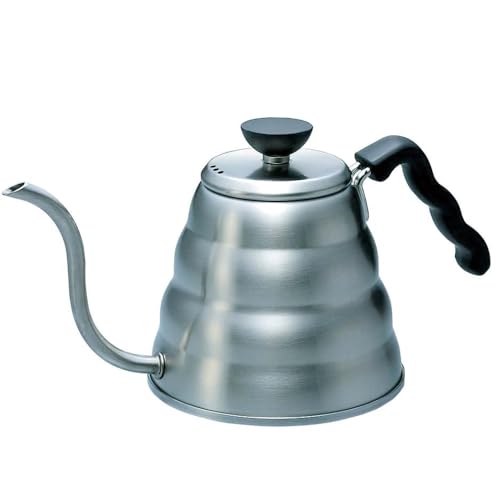
The Buono's spout is the one the rest of the category learned from, and it remains among the most controllable you can buy. Water leaves in a thin, straight stream that responds immediately to how far you tilt, which is exactly what a cone dripper wants. On pour quality alone it belongs higher on this page than its position suggests.
Everything else about it is a step backwards in convenience, which is the honest reason it sits fifth. There is no temperature reading, so hitting a brewing target means either a thermometer or the boil-and-wait routine. It heats slowly, because a hob is a slower way to move energy into water than an immersed element. On gas the handle gets hot enough to need a cloth. And while it holds 1.2 litres, the pour is noticeably harder to control when it is more than about two-thirds full, so the usable capacity is closer to 800ml.
Where it makes clear sense is away from a kitchen counter: camping, travel, a kitchen with no free socket, or as a second kettle that lives in a cupboard for occasional use. It is also the cheapest good pour on this page by some margin, which makes it a reasonable way to find out whether pour-over suits you before committing to an electric kettle.
The purest version of the idea and the best spout in the category, with none of the convenience. A deliberate choice rather than a default one.
Check price on Amazon →The spout is the product
Everything else in this category is a feature list. The spout is the reason gooseneck kettles exist, and it is what separates a kettle you enjoy using from one you tolerate. Three things distinguish a good one: the stream stays thin at a shallow tilt rather than only when you pour hard, it responds immediately when you change the angle, and it cuts off cleanly when you level the kettle instead of running back down the outside.
That last one is the tell. A kettle that dribbles will dribble every morning for as long as you own it, and no amount of technique compensates. If you can only evaluate one thing before buying, evaluate that.
Temperature control is worth less than the marketing suggests
It is the headline feature and the main price driver, and it is genuinely useful — but it is second to the spout, and the size of its effect depends entirely on what you drink. Light roasts are dense and hard to extract; brewing them below about 94°C tends to produce sourness that people then blame on their grinder. Medium and dark roasts extract readily and taste much the same anywhere in the sensible range.
The stronger argument for it is not accuracy but repeatability. A kettle you set to a number removes a variable permanently, which means that when a brew goes wrong you have one fewer thing to suspect. That is the same reason a scale earns its place: not because it makes coffee better, but because it makes the process legible.
Where a kettle sits in the order of spending
If you are building a pour-over setup from nothing, the kettle is the second thing to buy, after the grinder and before the dripper. A cone dripper without a controllable pour is close to unusable; a grinder that produces boulders and dust cannot be rescued by any kettle. Pour-over basics covers the technique all of this is in service of, and best pour-over drippers covers the brewer at the other end of the pour — including the flat-bottomed options that need far less from a kettle than a V60 does.
Frequently asked questions
Do I really need a gooseneck kettle?
For cone drippers like the V60, effectively yes. An ordinary kettle pours a wide, fast stream that digs into the coffee bed, splashes grounds up the filter wall and cannot be stopped precisely, and all three of those produce uneven extraction. For flat-bottomed brewers with restricted outlets, and for French press or AeroPress, an ordinary kettle is fine — the brewer is doing the work that a careful pour would otherwise do.
Is temperature control worth the extra money?
It depends on what you drink. Light roasts are harder to extract and genuinely benefit from the hot end of the range, so if you buy light and want to taste what the roaster intended, temperature control earns its money. For medium and dark roasts, boiling and waiting sixty seconds with the lid open lands in the right neighbourhood, and few people would pick the difference out blind. The stronger practical argument is repeatability rather than accuracy: a number you can set is a variable you have removed.
What temperature should I brew pour-over at?
Between roughly 90°C and 96°C, and hotter within that band for lighter roasts. The common mistake is brewing too cool rather than too hot, which gives a sour, thin cup that people usually blame on the grind. If you are guessing rather than measuring, water off a rolling boil with the lid open for about a minute lands near the middle of the range in a normal kitchen.
How full should I fill a gooseneck kettle?
Two-thirds at most if you care about the pour. A full kettle is heavy and wants to tip faster than you intend, which makes the first and most delicate pour — the bloom — the hardest one of the brew. This matters more on kettles without a counterbalanced handle, and it is the main reason a nominally 1.2-litre stovetop kettle behaves like an 800ml one.
Are stovetop gooseneck kettles worth considering?
Yes, in specific situations. They pour as well as anything electric, cost less, have nothing electronic to fail, and work anywhere you can apply heat — which makes them the obvious choice for camping or a kitchen short of sockets. What they cost you is time and information: slower heating, no temperature reading, and no way to hold a temperature once the kettle leaves the hob.
Why does my kettle dribble down the outside when I stop pouring?
It is a spout design fault and it is not something you can fix with technique. A well-cut spout breaks the stream cleanly when you level the kettle; a poorly-cut one lets surface tension pull the last of the water back along the underside. It is the single most reliable way to tell a good gooseneck from a cheap one in the first week of use, and it is worth returning a kettle over.