Best Tampers, Distributors and WDT Tools
These three tools all address the same failure. Water forced through a coffee bed at nine bar takes the easiest route available, so if one part of the puck is looser than the rest, the water carves a channel through it and races out — over-extracting that path and barely wetting everything else. That is channelling, and it is why a shot can run fast and taste sour and bitter at the same time. A WDT tool breaks up the clumps that create those loose spots, a tamper compresses the bed evenly, and a distributor levels the surface before tamping. They are not equally important, and the order in which most people buy them is close to backwards. We compared the tools most consistently recommended for home espresso on published specifications, manufacturer documentation and owner reports at scale, and ranked them by how much of the channelling problem each one actually removes.
As an Amazon Associate, Cafe & Crema earns from qualifying purchases. This never affects the price you pay. How we make money.
| Rank | Product | Score | Best for | Link |
|---|---|---|---|---|
| #1 | Normcore 58.5mm Coffee Tamper V4Top pick | 9.4 | Anyone with a 58mm machine who wants tamping to stop being a variable | Check price → |
| #2 | Normcore 58mm Adjustable Needle Distribution Tool V2Best WDT tool | 9.2 | Everyone pulling espresso, at any budget, before any other accessory | Check price → |
| #3 | Normcore 53.3mm Coffee Tamper V4Best for Breville | 9.0 | Breville and Sage owners who have switched to non-pressurised baskets | Check price → |
| #4 | Rattleware 58mm Stainless Steel Espresso TamperBest simple tamper | 8.2 | Someone who wants a proper tamper without a mechanism, or who already tamps well | Check price → |
| #5 | Normcore 58.5mm Coffee Distribution ToolOptional extra | 7.6 | Someone who already owns a WDT tool and a good tamper and wants the last refinement | Check price → |
#1 · Our PickTop pick
Normcore 58.5mm Coffee Tamper V4
Best for: Anyone with a 58mm machine who wants tamping to stop being a variable
What we like
- Levelling plate rests on the basket rim, so the tamp lands flat without eyeballing it
- Three interchangeable springs (15lb, 25lb, 30lb) with 25lb fitted from the factory
- 58.5mm base sits closer to the basket wall than a nominal 58mm tamper
- Stand included, which keeps the base off the counter
- Costs a fraction of the machined boutique tampers it competes with
What we don't
- 58.5mm is deliberately oversized and binds in a few stock baskets
- The spring release is quiet — the V4.1 revision exists because people wanted an audible click
- Heavy compared with a plain tamper, which some find tiring
- Removes the feedback you would otherwise learn to read from the puck
- Levelling plate can mark the coffee ring if the basket rim is not flat
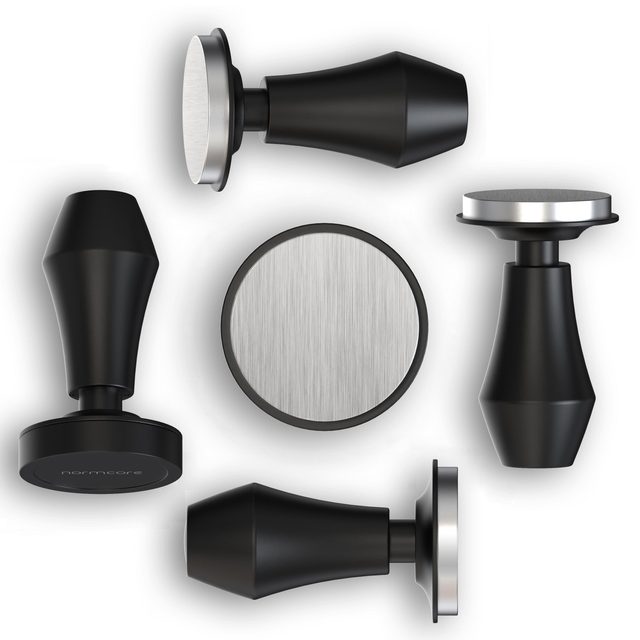
Tamping is the part of espresso that attracts the most folklore and rewards the least effort. The two things that matter are that the bed ends up level and that the force is the same every time; the exact pressure is far less important than most advice suggests. The V4 handles both mechanically. A levelling plate rests on the rim of the basket as you press, so the tamper cannot go in at an angle, and the spring releases at a set force, so a distracted morning and a careful one produce the same puck.
The execution is unusually good for the price. Three springs ship in the box — 15lb, 25lb and 30lb, with 25lb fitted — so you can find a force you like and then stop thinking about it. The base is 58.5mm rather than a nominal 58mm, which matters more than half a millimetre sounds: a tamper noticeably smaller than the basket leaves an unsealed ring of grounds at the wall for water to exploit, and this one closes that gap in most 58mm baskets including the VST and IMS precision baskets people upgrade to. A stand comes with it, which sounds trivial until you have set a wet tamper base down on a gritty counter a few times.
The caveats are real but narrow. Oversizing cuts both ways: in a handful of stock baskets 58.5mm is tight enough to bind, and it is worth measuring rather than assuming. The spring release on the V4 is quiet, and the fact that Normcore released a V4.1 whose headline feature is an audible click tells you owners found it hard to feel. It is heavy, it will not teach you to read a puck by hand, and on a basket with an uneven rim the levelling plate can leave a mark. None of that outweighs what it does, which is delete one of the three inputs you would otherwise have to control by hand.
The tool that turns tamping from a skill into a setting. If you buy one thing from this article, buy this — but buy the WDT tool below first if you can only afford one.
Check price on Amazon →#2Best WDT tool
Normcore 58mm Adjustable Needle Distribution Tool V2
Best for: Everyone pulling espresso, at any budget, before any other accessory
What we like
- Nine 0.3mm 304 stainless needles, fine enough to pass through the bed without dragging it
- Rotating anodized aluminium handle makes the stirring motion effortless
- Sits on the basket so the needles reach a consistent depth every time
- Addresses clumping, which is the largest single cause of channelling
- Cheapest meaningful upgrade in espresso by a wide margin
What we don't
- Adds ten to fifteen seconds to every shot
- 0.3mm needles bend if you push rather than stir
- Needles collect grounds and static, and want a wipe between shots
- No case, so the needles are exposed in a drawer
- Does nothing for a grinder that is fundamentally inconsistent
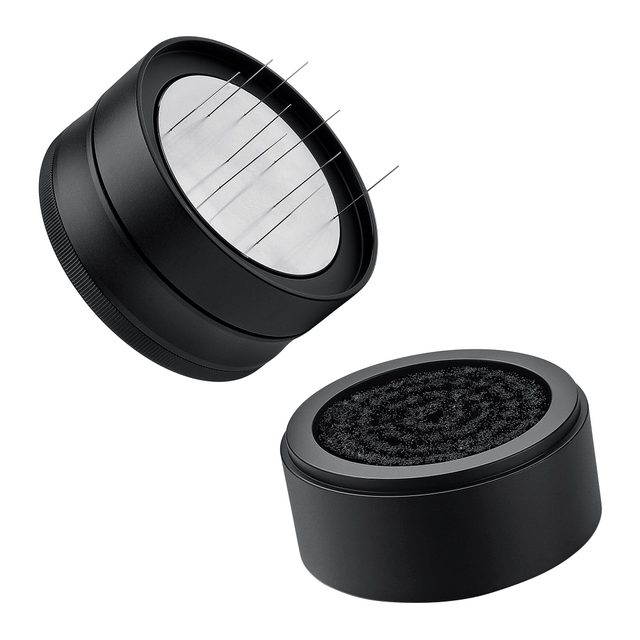
Coffee does not fall out of a grinder as a uniform powder. It falls out in clumps, held together by static and by the oils in the beans, and those clumps survive tamping as denser and looser regions inside the puck. That is a channel waiting to happen, and no amount of tamping technique fixes it, because tamping compresses what is already there rather than redistributing it. Stirring the grounds with fine needles before you tamp — the Weiss Distribution Technique, hence WDT — breaks the clumps apart and is the reason this tool outranks everything else here on impact per dollar.
The V2's specification is well judged for the job. Nine needles at 0.3mm in 304 stainless is fine enough to pass through the bed and separate clumps without dragging the whole mass around, which is the failure mode of tools using thicker wire. The handle rotates freely, so the stirring motion is a flick of the fingers rather than a wrist exercise, and the body sits on the basket so the needles enter to the same depth on every shot rather than however deep you happened to push. Owners consistently describe the same thing after adopting one: shot times that stop varying by several seconds between identical doses.
What it asks of you is patience and a light touch. It adds ten to fifteen seconds per shot, which is nothing in principle and irritating on a weekday morning. The needles are fine enough to bend if you press downward instead of stirring, and they collect grounds and static that want wiping off. It ships without a case, so in a crowded drawer the needles are vulnerable. And it cannot rescue a grinder that produces genuinely inconsistent particle sizes — it redistributes what the grinder gives it. Within those limits, nothing else in home espresso improves shots this reliably for this little money.
The highest-impact purchase in this article and among the cheapest. Buy this first, then the tamper above.
Check price on Amazon →#3Best for Breville
Normcore 53.3mm Coffee Tamper V4
Best for: Breville and Sage owners who have switched to non-pressurised baskets
What we like
- Sized for the 54mm baskets used across the Breville and Sage range
- Same levelling plate and interchangeable spring system as the 58.5mm version
- Replaces the light plastic tamper Breville includes, which is the weakest part of the box
- Stand included
- One tool covers the Bambino, Barista Express, Barista Pro and Barista Touch
What we don't
- Only useful once you move off Breville's pressurised baskets
- Same quiet spring release as the 58.5mm V4
- Heavier than the stock tamper, which is the point but takes adjusting to
- Does not fit the 58mm machines most upgrade paths lead to
- Breville's own magnetic tamper dock will not hold it
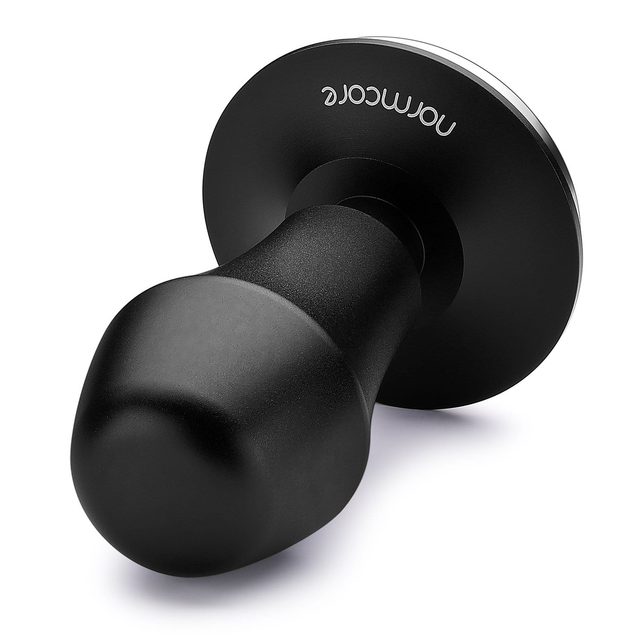
Breville and Sage machines use 54mm portafilters, which puts their owners outside the 58mm ecosystem that most espresso accessories are built for. It also means the tamper in the box is a lightweight plastic item sized slightly under the basket, which leaves a ring of loose grounds at the wall and cannot apply consistent force. Given how many people start home espresso on a Bambino or Barista Express, this is probably the most commonly needed accessory in the category.
The 53.3mm V4 is mechanically identical to the 58.5mm version above: the levelling plate rests on the basket rim so the tamp lands flat, and the spring sets the force with 15lb, 25lb and 30lb options in the box. The nominal 53.3mm figure is again slightly under the marketing size of the basket rather than over it, which is the correct relationship for a 54mm basket, and it clears the wall without leaving the gap the stock tamper does. It covers the whole current Breville range with one purchase.
The one thing worth understanding before buying is sequencing. Breville ships most machines with pressurised (dual-wall) baskets, which create back-pressure artificially and make puck preparation nearly irrelevant — a good tamper does almost nothing until you switch to single-wall baskets. If you are still on the pressurised ones, buy those first and this second. Beyond that the caveats match the larger version: the spring release is quiet, it is heavier than what it replaces, and it will not carry over if you later move to a 58mm machine. Breville's magnetic tamper dock will not hold it either, which is a small daily annoyance.
The same tamper in the size Breville owners actually need. The stock plastic tamper is the single cheapest part of an otherwise good machine, and this replaces it properly.
Check price on Amazon →#4Best simple tamper
Rattleware 58mm Stainless Steel Espresso Tamper
Best for: Someone who wants a proper tamper without a mechanism, or who already tamps well
What we like
- Solid stainless steel with a flat base and no mechanism to fail
- Rattleware has supplied commercial cafés for decades
- Lighter and quicker to use than a spring-loaded tamper
- Nothing to adjust, clean around or re-spring
- Costs meaningfully less than the calibrated tampers above
What we don't
- No calibration, so consistency is entirely down to you
- No levelling plate, so a tilted tamp is possible and invisible
- Nominal 58mm leaves more wall gap than the 58.5mm tampers above
- No stand included
- Handle shape is a matter of taste and cannot be swapped
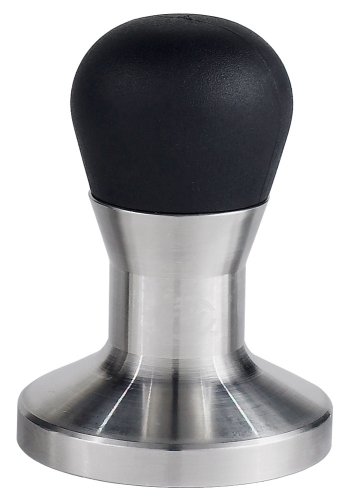
Before calibrated tampers, cafés used solid metal ones and produced excellent espresso, which is worth remembering when the accessory market implies otherwise. Rattleware has been supplying that market for decades, and this is the plain version of the tool: stainless steel, flat base, ergonomic handle, no springs, no plates, nothing that can wear out or need re-tensioning. It will outlast every other item in this article and it costs less than most of them.
The case for it is more than nostalgia. A spring-loaded tamper is heavier and slower, and it deliberately removes the tactile feedback of the puck compressing under your hand — feedback that experienced baristas use to notice a dose that is off before the shot runs. If you tamp level reliably, a calibrated tamper buys you very little, and this buys you durability and speed instead.
The case against it is that most people do not tamp level reliably, and a tilted tamp is invisible until the shot runs unevenly. There is no levelling plate to prevent it and no spring to standardise force, so both variables stay in your hands. It is also a nominal 58mm rather than 58.5mm, which leaves a slightly wider gap at the basket wall than the Normcore tampers above, and no stand comes with it. Buy it if you want a tool rather than a device, and pair it with the WDT tool at rank two, which will do more for your shots than any tamper will.
A good, plain, commercial-grade tamper that does exactly what a tamper did before springs existed. Cheaper and more durable than the picks above, and it makes you supply what they supply for you.
Check price on Amazon →#5Optional extra
Normcore 58.5mm Coffee Distribution Tool
Best for: Someone who already owns a WDT tool and a good tamper and wants the last refinement
What we like
- Wedge depth adjusts from 4mm to 12mm to suit your dose
- Anodized aluminium and stainless construction with a distributor stand
- Levels the surface of the bed quickly and repeatably
- Genuinely helps if your grinder mounds grounds unevenly in the basket
- Makes the tamp that follows easier to land flat
What we don't
- Solves less of the channelling problem than the WDT tool at a higher price
- Only levels the top of the bed; clumps underneath survive intact
- Set too deep it compacts the surface and can create channelling of its own
- Depth needs resetting whenever your dose changes
- Adds a step to a routine that already has several
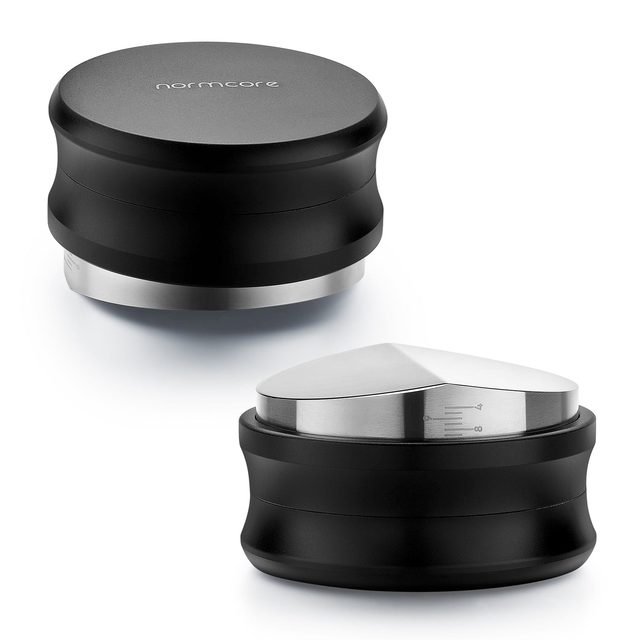
A distributor is a flat or bladed disc that you set to a fixed depth and spin on top of the dosed basket, sweeping the grounds level before you tamp. It is the most visually satisfying tool in espresso and the one that changes the least about the shot, which is a combination that explains its sales figures.
The Normcore version is well engineered for what it is. The wedge depth adjusts from 4mm to 12mm so you can match it to your dose rather than to whatever the factory chose, the build is anodized aluminium over a stainless base, and a stand is included as with the tampers. Used correctly it produces a visibly flat bed in a couple of seconds and makes the subsequent tamp easier to land level, which is a real if modest benefit — and a larger one if your grinder dumps grounds in a mound rather than spreading them.
The reason it ranks last is that it works on the surface. Levelling the top of the bed does nothing to the clumps sitting underneath it, and those clumps are what channelling is made of. Worse, a distributor set too deep compresses the top layer into a denser crust than the coffee below, which is a channelling mechanism in its own right — several owners who added one and got no improvement had done exactly this. It also needs resetting whenever the dose changes, and it lengthens a routine that already includes grinding, weighing, stirring and tamping. Buy it third, after the WDT tool and a decent tamper, and only if you enjoy the process enough to want the extra step.
The most-bought and least-necessary of the three tool types. Well made and genuinely useful in third place, which is exactly where it belongs.
Check price on Amazon →Buy them in order of what they fix
The three tools in this article are usually presented as a set, and they are not equally useful. Clumping is the largest cause of channelling, and only the WDT tool addresses it. Tilt and inconsistent force are the second, and a calibrated tamper handles both. Surface unevenness is the third and smallest, and that is the distributor’s job. Buying in that order means each purchase gives you a smaller improvement than the last, which is the correct shape for spending money on accessories. Buying in reverse — the distributor first, because it is the most photogenic — is how people end up with a drawer of tools and shots that still run in eighteen seconds.
The tamper in your box is the weak link
Almost every espresso machine below the prosumer tier ships with a plastic tamper that is undersized relative to its own basket. That gap at the basket wall is a channel with a head start, and the light weight makes even force awkward to apply. Replacing it is the cheapest meaningful improvement available to a new owner, and it does not require a calibrated model — a plain stainless tamper of the correct diameter fixes the actual defect. Measure the basket before ordering, because the number printed on the portafilter is a marketing size and the number you need is the one inside.
None of it substitutes for the grind
Every tool here operates on grounds the grinder has already produced. If the particle distribution is wide, or the grinder cannot adjust finely enough to reach the right extraction, no amount of stirring or levelling recovers it — you are arranging a compromised bed more neatly. That ordering is why our espresso grinder roundup comes before this one in every recommendation we make, and why how to build a home espresso setup puts the grinder in stage one and these tools in stage four. If you are still choosing hardware, start with the best espresso machines under $500 and spend what is left on the grinder, not the accessories.
Frequently asked questions
What is WDT and does it really work?
WDT stands for the Weiss Distribution Technique, which means stirring the dosed grounds with fine needles before tamping to break up clumps. It works, and the reason is mechanical rather than mystical: coffee leaves a grinder in static-bound clumps that survive tamping as denser and looser regions inside the puck, and water under pressure exploits the loose ones. Stirring destroys those clumps before the bed is compressed. It is the single most consistently reported improvement among people who add an accessory to their routine, and the tool costs less than a bag of good beans.
How hard should I tamp?
Less hard than the folklore suggests, and more consistently than most people manage. The often-quoted 30lb figure is not a target so much as a historical convention; anywhere from 15 to 30lb produces a sealed bed, and beyond the point where the coffee stops compressing further, additional force achieves nothing. What actually matters is that the bed ends up level and that you apply roughly the same force every time, because a shot you cannot reproduce cannot be improved. That is exactly why calibrated tampers exist — not because a specific pressure is magic, but because a repeatable one is.
Do I need a distributor if I have a WDT tool?
No. They overlap, and the WDT tool does the more important part of the job. A distributor levels the surface of the bed; a WDT tool redistributes the whole depth of it. If you own one, own the WDT tool. A distributor is worth adding afterwards as a refinement, particularly if your grinder deposits grounds in an uneven mound, but it is not a substitute and buying it first is the most common sequencing mistake in this category.
What size tamper do I need?
Measure the inside diameter of your basket rather than reading the number off the portafilter. Machines sold as 58mm generally want a tamper between 58 and 58.6mm, and many enthusiasts prefer 58.5mm because it closes the gap at the basket wall. Breville and Sage machines sold as 54mm want roughly 53.3mm. Smaller De'Longhi machines are usually 51mm. If a tamper is much smaller than the basket it leaves a ring of loose grounds for water to channel through, and if it is larger it will not seat at all, so this is worth two minutes with a ruler.
Is the tamper that came with my machine good enough?
Almost certainly not, and it is the cheapest thing to fix. Machines below the prosumer tier nearly always include a light plastic tamper that is undersized relative to the basket, which leaves an unsealed ring at the wall, and too light to apply meaningful force without an awkward push. Some are moulded into the end of the scoop. It is fine for your first week and a ceiling after that. A plain stainless tamper of the correct diameter costs very little and is a larger improvement than most upgrades several times its price.
Will these tools fix a bad grinder?
No, and it is worth being clear about the limit. Every tool here works on grounds that already exist — it redistributes, levels or compresses them. If your grinder produces a wide spread of particle sizes, or cannot adjust finely enough in the espresso range to hit the right extraction at all, the puck was compromised before any of these touched it. Fix the grinder first. Once the grind is right, these tools are what remove the remaining inconsistency.