Best Espresso Grinders
An espresso grinder is not a coffee grinder that happens to go fine. It is a grinder built so that the adjustment steps near the espresso range are small enough to steer with, because the difference between a shot that runs in 25 seconds and one that chokes can be a single fine increment. Plenty of well-reviewed grinders produce excellent pour-over and are useless for espresso, for exactly that reason: they reach the right fineness but offer four settings across the range where you need twenty. We compared the grinders most consistently recommended for home espresso against their published burr and adjustment specifications, long-term owner reports and independent expert testing, judging them primarily on adjustment resolution in the espresso range rather than on burr size or price.
As an Amazon Associate, Cafe & Crema earns from qualifying purchases. This never affects the price you pay. How we make money.
| Rank | Product | Score | Best for | Link |
|---|---|---|---|---|
| #1 | Baratza Encore ESP Coffee GrinderTop pick | 9.4 | Almost everyone starting home espresso, and most people who never leave it | Check price → |
| #2 | Baratza Vario Flat Burr Coffee GrinderBest adjustment | 9.2 | Someone who wants one grinder to do espresso and filter without compromising either | Check price → |
| #3 | Rancilio Rocky Espresso Coffee GrinderBuilt to last | 8.6 | Someone buying for durability, especially alongside a Rancilio Silvia | Check price → |
| #4 | Baratza Virtuoso+ Coffee GrinderBest dual-purpose | 8.4 | Households that brew mostly filter and pull espresso occasionally | Check price → |
| #5 | Breville Smart Grinder Pro BCG820BSSBest value | 8.0 | Pairing with a Breville Bambino or Bambino Plus on a tight total budget | Check price → |
#1 · Our PickTop pick
Baratza Encore ESP Coffee Grinder
Best for: Almost everyone starting home espresso, and most people who never leave it
What we like
- Dual-range adjustment: fine micro-steps 1-20 for espresso, coarser 21-40 for filter
- 40mm hardened alloy steel burrs made in Liechtenstein
- Single-handed hopper twist changes grind without tools
- Quick-release burr mount makes cleaning genuinely easy
- Baratza's parts and repair support is the best in home coffee
What we don't
- Stepped rather than stepless, so you cannot split the difference between settings
- Retains enough grounds that a setting change takes a shot to take effect
- Plastic body at a price where some rivals use metal
- No timer or weight-based dosing, so you dose on a scale
- Modest motor, slower than the pricier grinders here
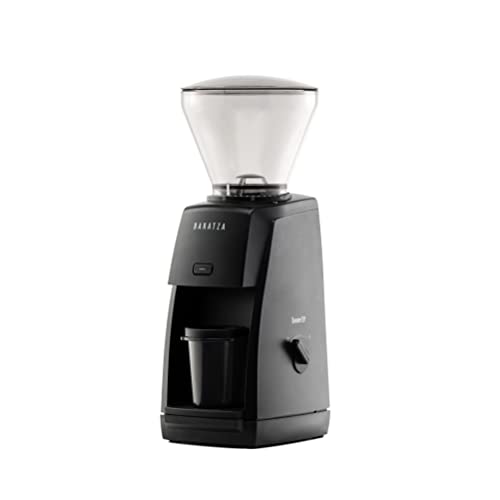
Most affordable grinders spread their settings evenly across the whole range from espresso to French press, which sounds fair and is the reason so many of them cannot do espresso. Half your settings end up in coarse territory you will never use, and the espresso range gets four or five steps that are each too large to correct with. The Encore ESP's answer is to split the range in two: settings 1 to 20 are fine micro-steps covering espresso, and 21 to 40 are coarser macro-steps for filter. That single decision is why it works, and why it is the default recommendation for a first espresso grinder.
The rest is competent rather than exciting, which is the right emphasis. The burrs are 40mm hardened alloy steel made in Liechtenstein, the same family Baratza has used for years, and they produce a grind consistent enough that the machine becomes the limiting factor rather than the grinder. Adjustment is a single-handed twist of the hopper, so changing beans does not involve tools. The burr mount releases quickly, which matters more than it sounds because a grinder you can actually clean is a grinder that keeps performing. Behind all of it sits Baratza's support operation, which sells parts and publishes repair guides for grinders a decade old — the strongest argument here for buying one that will still work in ten years.
The compromises are the ones you would expect at the price. It is stepped, not stepless, so when one setting runs a little fast and the next runs a little slow there is no way to land between them; you adjust dose or tamp instead. It retains grounds, so a setting change does not fully take effect until you have pulled a shot through it. The body is plastic where the Rocky is metal, there is no timer or weight dosing so you dose onto a scale, and the motor is unhurried. None of that displaces it. For getting a genuinely espresso-capable grind at the lowest sensible price, this is the one to buy, and the machine you pair it with will run out of headroom before it does.
The grinder that put usable espresso adjustment at an entry price. Its whole design is aimed at the one specification that matters, and nothing else here does that as cheaply.
Check price on Amazon →#2Best adjustment
Baratza Vario Flat Burr Coffee Grinder
Best for: Someone who wants one grinder to do espresso and filter without compromising either
What we like
- 230 grind settings through paired macro and micro levers
- 54mm flat burrs, larger and more uniform than the conical sets below
- Time-based dosing to a tenth of a second with three programmable presets
- Removable portafilter holder grinds straight into the basket
- Covers espresso and filter properly rather than compromising between them
What we don't
- Much more expensive than the Encore ESP for a smaller improvement than the price gap suggests
- Plastic body and hopper at a price where that grates
- Ceramic burrs divide opinion against steel on longevity and flavour
- Older design, and it looks it next to newer flat-burr grinders
- Retention is real, so single-dosing needs a routine
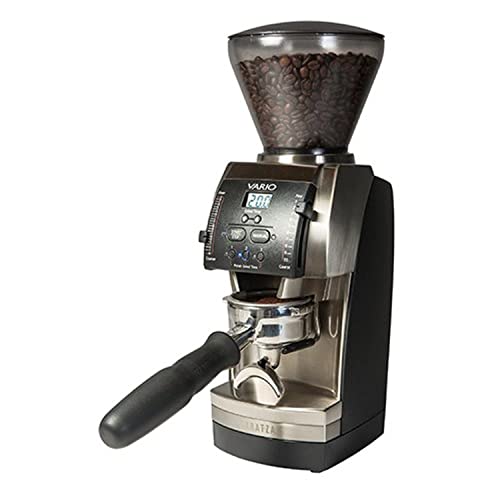
Where the Encore ESP solves the adjustment problem by splitting its range in two, the Vario solves it by having far more range to begin with. Paired macro and micro levers give 230 settings, which is enough that you can nearly always find the increment you want rather than choosing between one that is slightly too fast and one that is slightly too slow. For espresso that is the specification that matters most, and nothing else in this roundup approaches it. The burrs are 54mm flat, larger than the 40mm conical sets in the Baratzas below, and flat burrs generally produce a narrower particle distribution — which in practice means shots that are a little more consistent from one to the next.
The dosing side is equally considered. Grind time is programmable to a tenth of a second with three presets, so a household with an espresso setting, a filter setting and a decaf setting can switch between them without re-dialling, and the removable portafilter holder lets you grind straight into the basket rather than into a bin and out again. Taken as a whole it is the only grinder here that does espresso and filter properly rather than doing one well and tolerating the other.
The reservations are about value and age. It costs multiples of the Encore ESP and the improvement, while real, is smaller than the price gap implies — you are buying resolution and versatility rather than a step change in the cup. The body and hopper are plastic, which is easier to forgive at $170 than at this price. The ceramic burrs have their defenders and their critics, with the argument running to both longevity and flavour, and it is a genuine disagreement rather than a settled question. It is also an older design that shows its age against newer flat-burr grinders. Buy it if adjustment resolution and dual-purpose use are what you actually need; buy the Encore ESP if you only ever pull espresso.
The most adjustable grinder here by a distance, and the only one that genuinely serves espresso and filter equally. You pay for the resolution.
Check price on Amazon →#3Built to last
Rancilio Rocky Espresso Coffee Grinder
Best for: Someone buying for durability, especially alongside a Rancilio Silvia
What we like
- 50mm commercial flat steel burrs taken from Rancilio's café equipment
- Direct-drive motor and metal construction built to commercial standards
- Doserless design grinds straight into the portafilter
- Parts availability and serviceability going back two decades
- Pairs naturally with the Rancilio Silvia as a matched setup
What we don't
- 55 stepped settings, and the steps near espresso are coarser than ideal
- No timer or dosing automation of any kind
- Significant retention, which single-dosing makes worse
- Loud, heavy and dated in both looks and interface
- Costs more than the Encore ESP while adjusting less finely for espresso
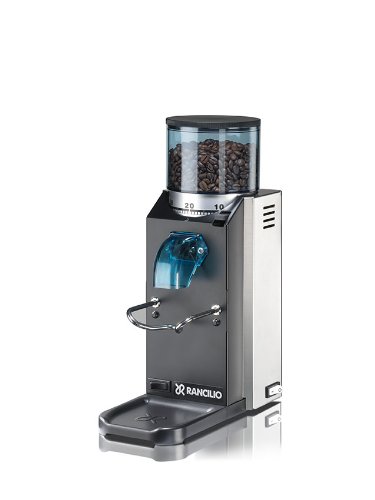
The Rocky is what happens when a commercial equipment maker builds a home grinder without softening anything. The burrs are 50mm commercial flat steel, the motor is direct-drive, the housing is metal, and the whole thing is designed to be taken apart and repaired rather than replaced — parts have been available for two decades, which is a claim almost nothing in home coffee can make. Alongside a Rancilio Silvia it makes a matched pair that will plausibly outlast every other setup in this roundup combined.
The grind quality from those burrs is genuinely good, and the doserless version grinds straight into the portafilter without an intermediate bin. If your criterion is cost per year rather than cost, the arithmetic favours it heavily.
What holds it back is the adjustment, and it is a real and well-documented limitation rather than a nitpick. There are 55 stepped settings across the whole range, and the steps in the espresso region are large enough that owners regularly report finding one setting that runs slightly fast and the adjacent one that chokes, with nothing in between. That is precisely the problem this article is about, and it is odd to find it on the most commercially built grinder here. Compounding it, there is no timer or dosing automation at all, retention is significant, and it is loud. The Encore ESP costs less and adjusts more finely for espresso specifically, which is why it ranks above. Buy the Rocky because you want a grinder your grandchildren could service, and be prepared to work around the steps.
A commercial grinder in a home body, held back by an adjustment system that is coarser than its burrs deserve. Buy it for the twenty-year lifespan, not the dial.
Check price on Amazon →#4Best dual-purpose
Baratza Virtuoso+ Coffee Grinder
Best for: Households that brew mostly filter and pull espresso occasionally
What we like
- 40 settings with commercial-grade M2 conical steel burrs
- 40-second digital timer adjustable to a tenth of a second
- LED-backlit grounds bin makes dosing easy to see
- Metal top and base rather than the Encore's all-plastic body
- Excellent across filter methods, from AeroPress to Chemex
What we don't
- Espresso sits at the very bottom of its range with few usable steps
- Not an espresso-first grinder despite being capable of espresso
- Costs more than the Encore ESP while adjusting worse for espresso
- Timer doses by time, not weight, so a scale is still required
- Retention is comparable to the Encore, without the ESP's range split
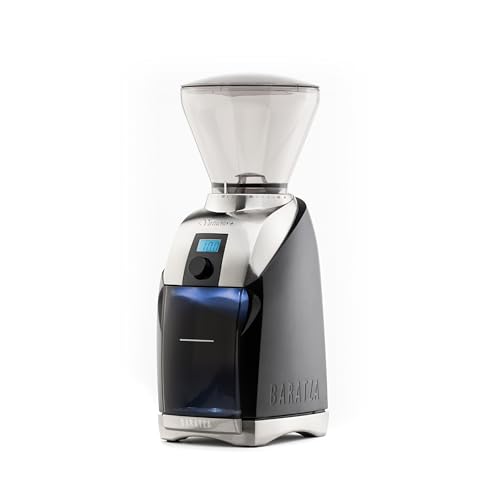
The Virtuoso+ is a better-built and better-equipped grinder than the Encore ESP in almost every respect, and it is the wrong choice for most people reading an article about espresso grinders. That contradiction is worth unpacking, because the specification sheet does not make it obvious. It has 40 settings, commercial-grade M2 conical steel burrs, a 40-second digital timer adjustable to a tenth of a second, an LED-lit grounds bin and metal construction at the top and base. Across filter methods it is genuinely excellent, handling everything from AeroPress to Chemex with a consistency that justifies its reputation.
The problem is where those 40 settings sit. They are spread across the full range from espresso to coarse, which leaves espresso occupying the bottom handful of steps — the exact situation the Encore ESP was designed to fix by splitting its range. In practice that means dialling in espresso on a Virtuoso+ involves fewer usable increments than on a grinder costing meaningfully less, and you will more often find yourself between two settings with no way to land between them.
Everything else about it is a pleasure. The timer is genuinely useful for repeatability, the lit bin is a small thing you notice every morning, and the build quality sits a clear step above the Encore line. It doses by time rather than weight, so a scale is still part of the routine, and retention is broadly similar to the Encore's. The recommendation is straightforward: if your household drinks mostly pour-over and drip with espresso as an occasional treat, this is the better grinder and the ranking here understates it. If espresso is the main event, spend less and buy the Encore ESP.
A superb filter grinder that can reach espresso rather than an espresso grinder. If espresso is your main method, the cheaper Encore ESP is the better buy.
Check price on Amazon →#5Best value
Breville Smart Grinder Pro BCG820BSS
Best for: Pairing with a Breville Bambino or Bambino Plus on a tight total budget
What we like
- 60 settings, more than most grinders near its price
- Grind time programmable in 0.2 second increments
- Grinds directly into a portafilter, container or paper filter
- Stainless steel construction and a clear LCD
- The natural pairing for a Breville machine without a built-in grinder
What we don't
- The 60 settings cover the whole range, so espresso still gets relatively few
- Conical burrs and motor are outclassed by the Baratzas above
- Noticeable retention and static, especially with oily beans
- Times rather than weighs, so consistency depends on bean density staying constant
- Build is consumer-grade next to the Rocky
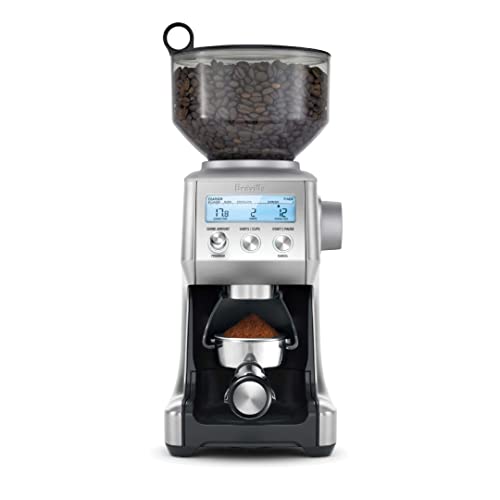
The Smart Grinder Pro exists to be the grinder you buy alongside a Breville machine that does not have one, and at that job it is well judged. Sixty settings is more than most grinders near its price offer, grind time is programmable in 0.2 second increments, and it will grind straight into a portafilter, a sealed container, a gold filter basket or a paper filter without adapters. The construction is stainless rather than plastic, and the LCD is clear about what it is doing. Paired with a Bambino or Bambino Plus it produces a complete setup for less than a single all-in-one machine costs.
The important thing it gets right is clearing the bar at all. Most grinders at this price cannot make real espresso, because they either lack the fineness or lack the adjustment resolution to steer once they get there. This one manages both well enough that a beginner can dial in a shot and improve it.
What it does not do is compete with the Baratzas above, and the specification that gives it away is the same one as everywhere else in this roundup: those 60 settings cover the full range from espresso to French press, so the espresso region gets a fraction of them rather than the dedicated fine range the Encore ESP provides. The burrs and motor are a clear step down, retention and static are noticeable and worse with oily dark roasts, and because it doses by time rather than weight your dose drifts as beans age and change density. Treat it as the sensible floor rather than a destination: it is the right purchase on a fixed small budget, and the first thing you will want to upgrade.
The most grinder for the money if the budget is fixed and small. It is outclassed above, but it clears the bar that most grinders at this price do not.
Check price on Amazon →Resolution beats every other specification
The single number that predicts whether a grinder will work for espresso is how many adjustment steps fall between a shot that runs too fast and one that chokes. Everything else — burr diameter, motor wattage, settings count, price — is secondary to that. It is why the Encore ESP, the cheapest grinder in this roundup, outranks two more expensive Baratzas for espresso specifically: it dedicates half its range to fine grinding instead of spreading its steps from espresso to French press. When you read a specification sheet, mentally discard any settings the grinder offers above medium, then ask whether what remains is enough to steer with.
Flat and conical is a smaller question than it sounds
Flat burrs produce a narrower particle distribution and are what commercial espresso grinders use, so they carry a deserved reputation. But the gap between a good conical grinder and a good flat-burr grinder is much smaller than the gap between fine adjustment and coarse adjustment, or between well-made burrs and cheap ones. The Vario’s flat burrs are part of why it is here, but its 230 settings are more of the reason. Treat burr geometry as a tiebreaker between otherwise comparable grinders rather than as the first thing to shop on.
Buy the support record
A grinder is one of the few things in a coffee setup with genuinely wearing parts: burrs dull, motors age, and gearboxes fail. That makes the manufacturer’s parts and repair record a real specification rather than a nicety. Baratza built its reputation as much on selling parts and publishing repair guides for decade-old grinders as on the grinders themselves, and Rancilio supports the Rocky the way it supports its café equipment. A cheaper grinder from a brand with no parts channel is a disposable object, and over ten years that is usually the more expensive choice.
The grinder is the first purchase, not the last — see how to build a home espresso setup for the full order, and our roundups of the best espresso machines under $500 and under $1000 for what to pair it with.
Frequently asked questions
Can I use a regular coffee grinder for espresso?
Usually not, and the reason is adjustment rather than fineness. Many general-purpose burr grinders can physically grind fine enough for espresso, but they offer only a few settings across that range, so you end up with one setting that runs too fast and the next that chokes the machine, with nothing between them. Blade grinders cannot do it at all. If a grinder's marketing mentions espresso only as one item in a list of methods, check how many steps it actually has in the fine range before assuming it will work.
What does stepped versus stepless adjustment mean?
A stepped grinder clicks between fixed positions; a stepless one moves continuously, so you can land anywhere between two points. For espresso this matters more than for any other method, because the useful adjustments are small. On a stepped grinder you sometimes find that one setting pulls a shot slightly too fast and the next slightly too slow, and your only recourse is to change dose or tamp instead. Stepless removes that problem, and it is the main thing enthusiast grinders buy you. Every grinder in this roundup is stepped.
Are flat burrs better than conical burrs for espresso?
Flat burrs generally produce a narrower particle size distribution, which tends to mean more consistent extraction from shot to shot, and they are what most commercial espresso grinders use. Conical burrs are cheaper to make at a given quality, run cooler and slower, and many excellent espresso grinders use them. The burr geometry matters less than the quality of the burrs and the resolution of the adjustment: a good conical grinder with fine steps beats a mediocre flat-burr grinder with coarse ones.
How much should I spend on an espresso grinder?
Enough that it is not the limiting factor in your setup, which at the entry level means roughly comparable to the machine. A $200 grinder with a $300 machine is a sensible balance; a $50 grinder with a $500 machine wastes most of the machine. Above about $400 the improvements become real but subtle — better consistency, finer adjustment, less retention — and are worth it mainly to people who have already got their technique to the point where the grinder is what is holding them back.
What is grind retention and does it matter?
Retention is the coffee left inside the grinder after a dose, and it matters in two ways. It means a grind adjustment does not fully take effect until you have pushed the old grounds through, which makes dialling in slower and more confusing. And it means changing beans gives you a first dose contaminated with the last variety. If you pull the same beans every day it is a minor annoyance. If you switch beans often, or single-dose by weighing beans in for each shot, it becomes the thing you notice most.
Do I need a separate grinder if my machine has one built in?
Not immediately, but it is the most common upgrade for a reason. Built-in grinders on machines like the Breville Barista Express are genuine burr grinders with dose control, and they make good espresso. Their limitation is step count and grind quality relative to a dedicated unit at the same price. Owners who add a separate grinder later typically report a larger improvement than expected, which is the clearest indication of where an all-in-one's compromise actually sits.