Best Espresso Machines Under $1000
Between $500 and $1000 the question changes. Below $500 you are buying a machine and pairing it with a grinder; here, most of the money goes to machines with a grinder already inside, and the real decision becomes whether that is a good idea. An all-in-one is genuinely convenient and genuinely compromised — the built-in grinder is never as good as the separate one you could have bought with the same money. Some of these machines are worth it anyway, one of them abandons the idea entirely and spends everything on build quality, and one route out of the bracket is to ignore all of them. We compared the five most credible options against their published specifications, long-term owner reports and independent expert testing, and the buying guide explains when to reject the whole category.
As an Amazon Associate, Cafe & Crema earns from qualifying purchases. This never affects the price you pay. How we make money.
| Rank | Product | Score | Best for | Link |
|---|---|---|---|---|
| #1 | Breville Barista Pro Espresso Machine BES878Top pick | 9.2 | The buyer who wants one appliance, on the counter, ready in seconds, with no separate grinder | Check price → |
| #2 | Rancilio Silvia Espresso MachineBest build and steam | 9.0 | Someone who wants a machine that will outlast several replacements of anything else here | Check price → |
| #3 | Breville Barista Express Espresso Machine BES870XLBest value | 8.8 | Beginners who want the machine to explain itself, at the lowest sensible price | Check price → |
| #4 | Breville Barista Touch Espresso Machine BES880Best automated | 8.6 | Households where several people with different tastes all need to make their own drink | Check price → |
| #5 | De'Longhi La Specialista Arte Evo Espresso Machine EC9255MBest non-Breville all-in-one | 8.2 | Buyers who want an all-in-one but not a Breville, and who value milk technique over shot control | Check price → |
#1 · Our PickTop pick
Breville Barista Pro Espresso Machine BES878
Best for: The buyer who wants one appliance, on the counter, ready in seconds, with no separate grinder
What we like
- ThermoJet heating reaches extraction temperature in about three seconds
- Integrated conical burr grinder with 30 settings and dose control
- Digital PID temperature control and low-pressure pre-infusion
- Powerful manual steam wand that texturises properly once learned
- LCD shows shot timer and grind settings without a menu system
What we don't
- No pressure gauge, which the cheaper Barista Express still has
- The built-in grinder is good, not as good as a $300 dedicated one
- 54mm portafilter, away from the 58mm commercial standard
- Grind retention means the first shot after a setting change is a mixture
- Single boiler, so brewing and steaming are sequential
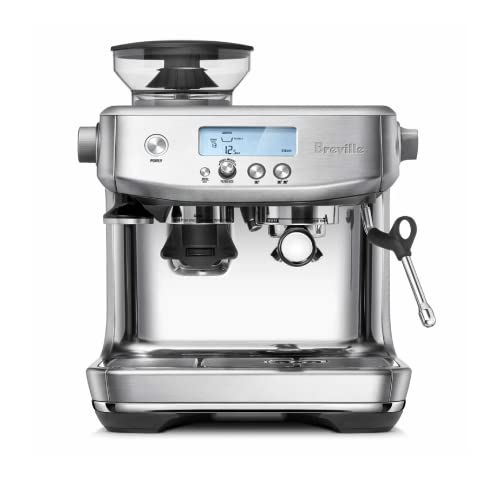
The Barista Pro is what the Barista Express became once Breville had the ThermoJet element to put in it. That single change is the reason to pick it: three seconds from standby to extraction temperature rather than the wait a thermocoil imposes, which is the difference between a machine you use every weekday and one you use when you have time. Around it sits an integrated conical burr grinder with 30 settings and dose control, digital PID temperature management, and low-pressure pre-infusion that ramps water in gently before full pressure.
What makes it the pick rather than the Barista Touch above it is where the extra money is not spent. There is no touchscreen, no saved drink profiles, no automatic milk texturing — just an LCD that shows you the shot timer and your grind setting, and a manual steam wand with real power behind it. Every dollar is in the parts that touch the coffee. The grinder is the honest compromise: it is a capable grinder that would cost perhaps $200 on its own, and it is genuinely convenient to have the beans, the dose and the portafilter cradle in one place, but it will not resolve the way a dedicated grinder at the same price does, and it retains enough grounds that the first shot after a grind adjustment is a blend of old and new settings.
The omission that irritates is the pressure gauge. The much cheaper Barista Express has one on the front, and it is the single most useful learning aid Breville makes; the Pro replaced it with a digital display that does not show extraction pressure at all. If you are new to espresso and want the machine to tell you why a shot ran fast, that is a real loss. It is also a 54mm portafilter and a single boiler, so the accessory market is Breville's rather than the commercial one and milk drinks involve a switchover. None of that dislodges it. For someone who wants espresso and milk on a weekday morning from one machine that occupies one patch of counter, this is the most sensible allocation of $1000 in the roundup.
The best-judged all-in-one at this price. It puts the money where it changes the coffee — heating and temperature control — rather than into a screen.
Check price on Amazon →#2Best build and steam
Rancilio Silvia Espresso Machine
Best for: Someone who wants a machine that will outlast several replacements of anything else here
What we like
- Commercial 58mm portafilter and a brass group head with serious thermal mass
- Brass boiler and commercial steam wand, both shared with Rancilio's café machines
- Iron frame and stainless panels, built to be repaired rather than replaced
- The strongest steam power of anything in this bracket
- Parts and service availability going back two decades
What we don't
- No PID as it ships, so brew temperature has to be managed by timing
- Fifteen to twenty minutes of warm-up before it is thermally stable
- No grinder, so the real budget is this machine plus a grinder
- No pressure gauge and no shot timer
- Small drip tray and a heavy machine to move
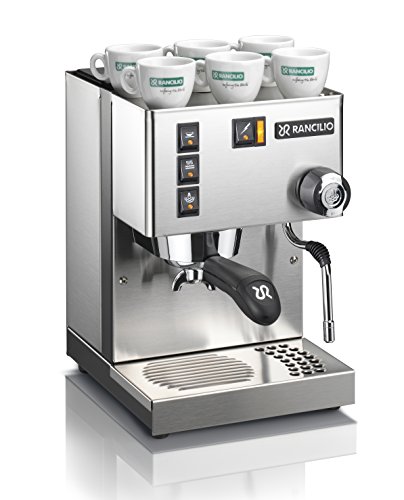
The Silvia is an odd thing to find on a list of home appliances, because it is essentially a single-group commercial machine with the automation removed. The portafilter is the 58mm commercial standard, the group head is brass with the thermal mass that implies, the boiler is brass rather than aluminium, and the steam wand is the same design Rancilio puts on machines that work in cafés. The frame is iron. The consequence is a machine that people are still using, and still getting parts for, two decades after buying it — a claim nothing else here can make.
The steam is the part that surprises people. Every other machine in this roundup steams milk adequately; the Silvia steams it the way a café machine does, with enough power to texture a full pitcher quickly rather than slowly working a small one. Combined with the 58mm portafilter, which connects you to the entire commercial accessory market of bottomless portafilters, precision baskets and distribution tools, it has by a distance the highest ceiling here.
The price of that is every convenience. There is no PID as it ships, so the boiler cycles around a thermostat and you learn to time your shot against that cycle rather than setting a number. It wants fifteen to twenty minutes to reach thermal stability, not three seconds. There is no shot timer, no pressure gauge, no grinder, and the drip tray is small. Critically, there is no grinder, which means the honest budget is this machine plus a serious grinder, pushing the real total past the bracket. Buy it if you want the machine to be the last one you buy and you are willing to supply the patience and the grinder yourself. Buy the Barista Pro if you want coffee at seven in the morning without ceremony.
The one machine in the bracket built to commercial standards rather than consumer ones. It gives you nothing convenient and everything durable.
Check price on Amazon →#3Best value
Breville Barista Express Espresso Machine BES870XL
Best for: Beginners who want the machine to explain itself, at the lowest sensible price
What we like
- Pressure gauge on the front, the best learning aid on any machine here
- Integrated conical burr grinder with dose control
- PID temperature control and low-pressure pre-infusion
- The deepest long-term owner record of any home espresso machine
- Usually the cheapest route to a machine and grinder together
What we don't
- Thermocoil heating, so a real warm-up wait rather than the Pro's three seconds
- Older platform, with a slower and less refined grinder than the Pro's
- Grind retention is noticeable and the hopper is awkward to empty
- 54mm portafilter, same limited accessory market as the rest of the Breville line
- Manual steam wand only, with no automatic milk mode
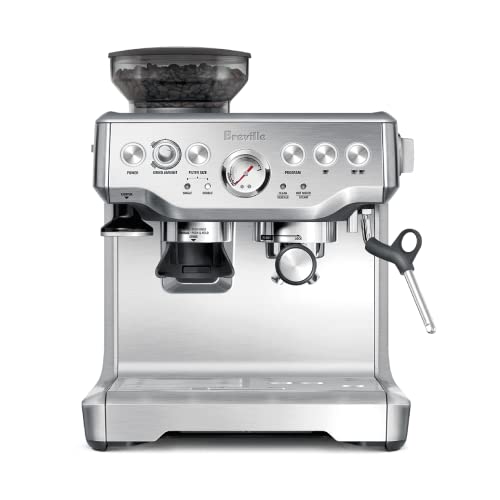
The Barista Express has been the default recommendation for home espresso for over a decade, and it has earned that position by being the machine that teaches. The pressure gauge on the front panel is the reason. Grind too coarse and the needle sits low while the shot gushes; grind too fine and it pins high while nothing comes out. That is real-time feedback on the one variable that matters most, and it is genuinely strange that Breville removed it from the newer, more expensive Barista Pro in favour of a digital display.
Everything else is a slightly older version of the Pro. The same style of integrated conical burr grinder with dose control, PID temperature management, low-pressure pre-infusion, 54mm portafilter, manual steam wand. It also has by far the deepest owner record of anything in this roundup, which matters more than it sounds: the failure modes are documented, the parts are available, and the repair guides exist, because millions of these have been in kitchens long enough for all of that to accumulate.
What you give up is speed and refinement. The thermocoil takes a real warm-up rather than three seconds, which sounds minor and is the single most common reason people stop using an espresso machine. The grinder is slower and noisier than the Pro's and retains enough coffee that adjustments take a shot or two to take effect, and the hopper is awkward to empty when you change beans. It is the same 54mm system with the same accessory ceiling. If the budget stretches to the Pro and you value your mornings, buy the Pro. If it does not, or if you are learning and want the gauge, this remains the most machine per dollar in home espresso.
Older and slower than the Pro, and still the better teacher because of one analogue dial. The value case in this bracket is entirely its.
Check price on Amazon →#4Best automated
Breville Barista Touch Espresso Machine BES880
Best for: Households where several people with different tastes all need to make their own drink
What we like
- Automatic milk texturing across eight texture levels and a wide temperature range
- ThermoJet heating, ready in about three seconds
- Touchscreen walks you through grind, brew and milk step by step
- Stores up to eight personalised drinks for different people or beans
- Integrated conical burr grinder with dose control
What we don't
- The most expensive machine here and the extra money buys interface, not extraction
- A touchscreen is a failure point that a dial is not
- No pressure gauge
- Same 54mm portafilter and same grinder compromises as the rest of the line
- Guided prompts can substitute for understanding rather than building it
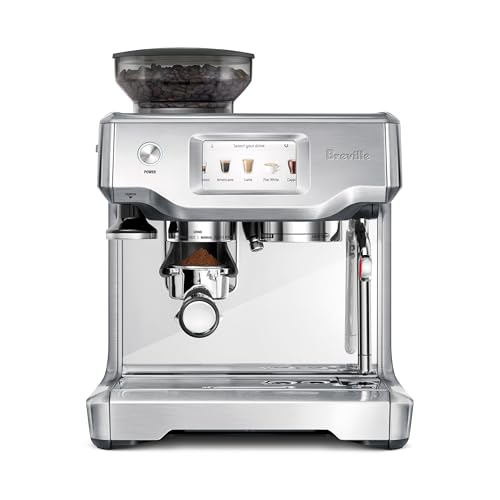
The Barista Touch answers a question the other machines here do not: what if nobody in the house wants to learn espresso? The touchscreen walks through grinding, brewing and milk as a sequence of prompts, the automatic steam wand textures milk to one of eight levels at a temperature you choose, and up to eight drinks can be saved so that different people, or different beans, get their own settings. Underneath it is a ThermoJet element, so it is ready in about three seconds, and the same integrated conical burr grinder with dose control that the rest of the line uses.
It genuinely works. The milk texturing produces proper microfoam rather than the bubbly foam a frothing aid makes, and for a household where three people each want a different drink and none of them want a hobby, it removes every barrier at once. Taken purely as an appliance that reliably produces good milk-based coffee, it is the most capable machine in the roundup.
The reservations are about where the money goes. Extraction-wise this is a Barista Pro; the premium buys the screen, the automation and the stored profiles rather than anything that touches the coffee. There is no pressure gauge, the portafilter is the same 54mm, and the grinder carries the same retention compromises. The touchscreen is also a component that can fail in a way a dial cannot, on a machine expensive enough that you want it working in five years. And there is a subtler cost: the guided prompts can stand in for understanding, so it is possible to own one for a year and still not know why a shot ran fast. If that trade sounds fine, this is a very good machine. If it sounds like paying more to learn less, the Barista Pro is the same coffee for less money.
The espresso machine as appliance. It makes very good coffee with almost no learning, which is either exactly what you want or precisely the problem.
Check price on Amazon →#5Best non-Breville all-in-one
De'Longhi La Specialista Arte Evo Espresso Machine EC9255M
Best for: Buyers who want an all-in-one but not a Breville, and who value milk technique over shot control
What we like
- Built-in conical burr grinder with a dedicated cold brew setting
- My LatteArt steam wand is a real commercial-style wand, not a frothing aid
- Active temperature control across several preset recipes
- Ships with single-wall baskets rather than only pressurised ones
- Compact for a machine with a grinder inside
What we don't
- Only eight grind settings, which is coarse adjustment for espresso
- Preset recipes do more of the deciding than an enthusiast will want
- Smaller accessory market than either the 58mm or Breville's 54mm ecosystem
- Build leans on plastic where the Rancilio is metal
- Cold brew function is a genuine feature but not why you buy an espresso machine
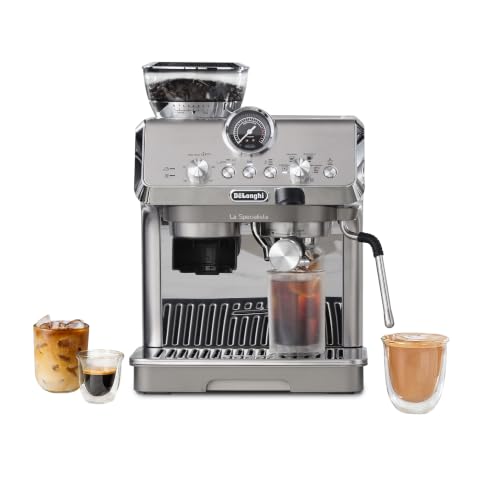
Three of the five machines in this roundup are Brevilles, which is a fair reflection of who owns this bracket rather than an editorial preference, and the La Specialista Arte Evo is the most credible alternative. It puts a conical burr grinder, a genuine commercial-style steam wand and active temperature control into a smaller footprint than most machines with a grinder inside, and it ships with single-wall baskets rather than defaulting to the pressurised ones that hide what your grind is doing. The My LatteArt wand deserves particular credit: it is a real steam wand that builds microfoam you can pour with, not the panarello sleeve that De'Longhi used at lower price points for years.
For someone whose drinks are mostly milk-based and who wants to actually learn to texture, that wand plus the compact footprint is a strong combination, and the cold brew setting is a real if peripheral addition.
The limitation is the grinder, and it is the thing that decides the ranking. Eight grind settings is not many for espresso, where the useful adjustments are small and the difference between a shot that runs in 25 seconds and one that runs in 35 can be a single fine step. With eight steps across the range you will frequently find yourself between two settings, one slightly too fast and one slightly too slow, with no way to split the difference — and unlike a Breville, where the same complaint applies less severely, there is no large aftermarket to escape into. The preset recipes similarly make decisions on your behalf. Buy it because you want the steam wand and a break from the Breville line-up, and accept that the grinder sets the ceiling.
A well-made alternative to the Breville monoculture, held back by a grinder with too few steps. Buy it for the steam wand, not the grind.
Check price on Amazon →Decide on separates before you shop
The defining feature of this price bracket is the built-in grinder, and the most useful thing to know is that it is optional. Roughly $800 spent on an all-in-one buys a machine worth around $500 with a grinder worth around $200 attached to it. The same $800 spent separately buys a better machine and a distinctly better grinder, at the cost of a second object on the counter. Since grind quality is the largest single influence on how espresso tastes, the separates route wins on the cup essentially every time in this range. What the all-in-one wins is space, workflow and the pleasure of one appliance doing everything — which are real, and are the reason to choose one deliberately rather than by default.
The feedback the expensive machines removed
There is a pattern worth noticing in the Breville line-up. The cheapest machine here, the Barista Express, has a pressure gauge. The pricier Barista Pro and Barista Touch do not. As the machines get more expensive they get faster, better automated and less communicative, replacing an analogue needle that shows you a bad extraction with screens that show you settings. For an experienced user who dials in by taste and timer that is no loss. For someone in their first year it inverts the usual assumption that paying more gets you more, and it is the strongest argument for the Barista Express surviving in a bracket where it is now the oldest design.
Durability is a specification too
The Rancilio Silvia is the least convenient machine in this roundup by a wide margin and the only one likely to still be working in fifteen years. Iron frame, brass boiler, brass group head, commercial steam wand, a parts supply that has existed for two decades. Every other machine here is a consumer appliance with a consumer appliance’s service life, and the ones with touchscreens and integrated grinders have more to go wrong. If you buy on cost-per-year rather than on price, the calculation looks very different from the way it looks on the shelf — provided you are the sort of person who will happily wait fifteen minutes for a machine to warm up.
If you already own a capable grinder, the smarter purchase is often a level down: see our best espresso machines under $500, and our guide to building a home espresso setup for how to stage the spend.
Frequently asked questions
Is a machine with a built-in grinder worth it?
It is worth it for convenience and against you on quality. An $800 all-in-one typically contains a machine worth around $500 and a grinder worth around $200, where buying separately at the same total would get you a better version of each. The genuine advantages are counter space and workflow — beans, dose and portafilter all in one place is genuinely pleasant. The genuine disadvantages are a grinder you cannot upgrade without replacing the whole machine, and a single point of failure. If you are optimising the cup, buy separates.
Why does the cheaper Barista Express have a pressure gauge when the Barista Pro does not?
Breville replaced the analogue gauge with a digital display when it moved the line to ThermoJet heating, and the display does not show extraction pressure. It is a real loss for beginners, because the gauge is the clearest available signal that your grind is wrong while there is still time to notice. The Pro is the better machine in almost every other respect — much faster heat-up, better grinder, better screen — so the choice is genuinely between speed and feedback rather than between old and new.
Do I still need a separate grinder if the machine has one built in?
No, and that is the point of buying one. The built-in grinders on these machines are real burr grinders with dose control and they will make good espresso. What they will not do is match a dedicated grinder at the same price, and their step count limits how finely you can adjust. Owners who later add a separate grinder usually report a bigger improvement than they expected, which is the clearest evidence of where the compromise sits.
Is the Rancilio Silvia worth buying without a PID?
Yes, if you accept what it asks. Without a PID the boiler cycles around a thermostat, so you learn to time the shot relative to that cycle — a technique usually called temperature surfing that takes a few weeks to become automatic. PID kits are widely available and commonly fitted, and the machine's brass boiler and group head hold heat well enough that the swing is smaller than the specification suggests. What you are really buying is a commercial-grade build with a 58mm portafilter and café-grade steam, and those do not degrade over the decade the machine will last.
How much better is $1000 than $500 in home espresso?
Less than the price difference implies, if you spend it on the machine alone. The biggest jumps in cup quality come from the grinder and from technique, both of which are available at $500. What the extra money buys here is convenience — an integrated grinder, automatic milk, faster heating — or durability, in the Rancilio's case. A $500 machine with a $300 grinder will usually beat a $900 all-in-one on taste. The bracket is worth it for what it does to your morning, not for what it does to your shot.
Which of these can make a proper cappuccino?
All of them, with different amounts of skill required. The Barista Touch textures milk automatically to eight levels and a set temperature, which needs nothing from you. The Barista Pro, Barista Express and La Specialista have capable manual wands that produce better milk than the automatic once you can use them, and worse until then. The Rancilio has the most powerful steam here by a clear margin and the least assistance, which makes it the best eventual milk machine and the most frustrating first one.