Best Coffee Grinders
The grinder decides more about how coffee tastes than the brewer does, which is the reverse of how most people spend their money. The reason is that brewing is a race: fine particles give up their solubles quickly and coarse ones slowly, so a grind containing both extracts unevenly no matter how carefully you pour. Dust turns bitter while boulders stay sour, in the same cup, and no technique separates them afterwards. A grinder's job is to narrow that spread. We compared the burr grinders most consistently recommended for home brewing on their published burr and adjustment specifications, long-term owner reports, independent expert testing and the manufacturers' records on parts and repair — the last of which matters more here than in any other category, because burrs wear and motors age.
As an Amazon Associate, Cafe & Crema earns from qualifying purchases. This never affects the price you pay. How we make money.
| Rank | Product | Score | Best for | Link |
|---|---|---|---|---|
| #1 | Baratza Encore Conical Burr Coffee GrinderTop pick | 9.4 | Almost anyone buying their first real grinder for filter coffee | Check price → |
| #2 | Baratza Virtuoso+ Coffee GrinderBest upgrade | 9.2 | Someone brewing filter coffee daily who wants the Encore's virtues with better parts | Check price → |
| #3 | OXO Brew Conical Burr Coffee GrinderBest value | 8.8 | Filter drinkers who want most of the Baratza result for meaningfully less money | Check price → |
| #4 | Breville Smart Grinder Pro BCG820BSSBest for espresso too | 8.2 | Households that brew filter coffee and also pull espresso on a Breville machine | Check price → |
| #5 | Capresso Infinity Conical Burr GrinderBest budget | 7.8 | A first burr grinder on a tight budget, or a second grinder for decaf | Check price → |
#1 · Our PickTop pick
Baratza Encore Conical Burr Coffee Grinder
Best for: Almost anyone buying their first real grinder for filter coffee
What we like
- 40 settings covering everything from espresso-adjacent to French press
- 40mm conical steel burrs made in Liechtenstein
- Gear-reduced DC motor runs slowly, which keeps heat and noise down
- Baratza publishes repair guides and sells parts for decade-old units
- Front pulse button for grinding a single dose without changing the timer
What we don't
- Plastic body at a price where some rivals use metal
- No timer or weight dosing, so a scale stays part of the routine
- Retains a couple of grams, so setting changes take a dose to register
- Slower than most electric grinders at fine settings
- Only marginally capable at espresso — the ESP variant exists for a reason
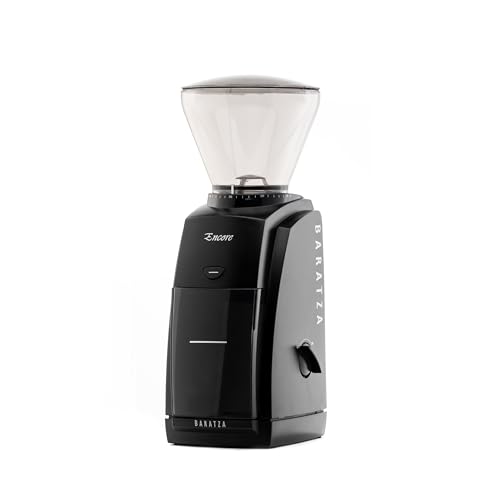
The Encore has been the standard answer to "what grinder should I buy" for long enough that its position deserves scrutiny rather than repetition. It holds up. The burrs are 40mm conical steel made in Liechtenstein, the same family Baratza has used across its range for years, and they produce a grind consistent enough that pour-over, drip, AeroPress and French press all improve audibly over anything a blade grinder or a cheap burr grinder produces. Forty settings is ample for filter brewing, where the useful adjustments are large.
The motor is the underrated part. It is a DC unit with gear reduction, which means it turns slowly rather than fast — less heat into the coffee, less noise in the kitchen, and less strain when it meets a dense bean. That design is also why the grinder is repairable rather than disposable, and Baratza has built its reputation on the follow-through: parts for sale, exploded diagrams published, repair guides written for grinders a decade old. Over ten years that is worth more than any specification on this page.
What you give up is refinement. The body is plastic, there is no timer and no weight dosing so you grind onto a scale, and it retains a couple of grams so a setting change takes a dose to fully register. It is not fast. And while it will reach espresso fineness, its settings are spread across the whole range, so espresso gets a handful of steps that are each too large to steer with — which is precisely why Baratza sells the Encore ESP as a separate model rather than telling people to use this one. For filter coffee, none of that displaces it.
The default recommendation in home coffee for over a decade, and still the right answer for most people. Nothing else at the price combines this grind quality with this repair record.
Check price on Amazon →#2Best upgrade
Baratza Virtuoso+ Coffee Grinder
Best for: Someone brewing filter coffee daily who wants the Encore's virtues with better parts
What we like
- Commercial-grade M2 conical steel burrs, a clear step above the Encore's
- 40-second digital timer adjustable in tenths of a second
- Metal top and base rather than the Encore's all-plastic construction
- LED-backlit grounds bin makes the dose easy to see
- Noticeably faster than the Encore at the same settings
What we don't
- Costs substantially more than the Encore for a modest gain in the cup
- Still 40 settings, so espresso is as constrained as on the Encore
- Times rather than weighs, so a scale is still required
- Retention is similar to the Encore's
- The timer tempts you into skipping the scale, which is a false economy
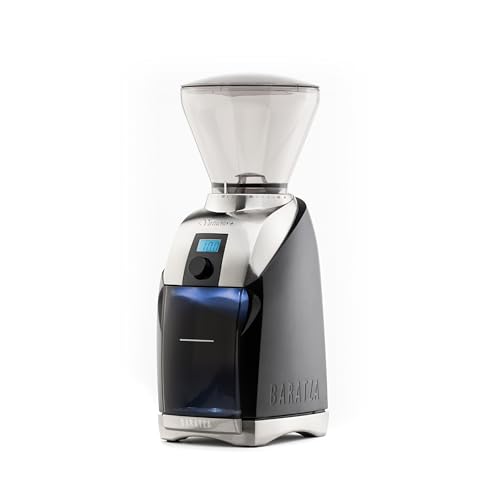
The Virtuoso+ is what the Encore becomes when the cost constraints loosen. The burrs step up to commercial-grade M2 conical steel, the top and base become metal, the motor gets quicker, and a 40-second digital timer adjustable in tenths of a second replaces the hold-a-button arrangement. A backlit grounds bin sounds like a gimmick and turns out to be one of those small daily conveniences you notice every morning.
In the cup the improvement is real and modest. Grind uniformity is better, which shows up as filter brews that taste slightly cleaner and vary slightly less between mornings, and the speed difference is obvious if you grind for several cups at a time. Neither is transformative, and anyone expecting the Encore-to-Virtuoso+ step to sound like the blade-to-burr step will be disappointed.
The honest framing is that this is a durability and convenience purchase more than a quality one. If you grind twice a day, every day, the better burrs and metal construction earn their keep over years. If you grind at weekends, the Encore does the same job for meaningfully less. One caution regardless: the timer measures seconds, not grams, and bean density changes as a bag ages, so a preset that delivered 20g in week one will not in week three. Keep using the scale.
The Encore with better burrs, better build and a timer. Whether that is worth the difference depends on how often you grind, not on how much you care.
Check price on Amazon →#3Best value
OXO Brew Conical Burr Coffee Grinder
Best for: Filter drinkers who want most of the Baratza result for meaningfully less money
What we like
- Stainless conical burrs with micro-adjustments between the main settings
- One-touch operation that remembers the last grind time
- Stainless steel construction that looks better than its price
- UV-blocking hopper and a container designed to limit static cling
- Widely available with strong retail support
What we don't
- Adjustment steps are coarse compared with the Baratzas above
- Not a serious espresso grinder despite reaching fine settings
- Timed dosing drifts as beans age
- Plastic gears in the drive train rather than the Baratzas' serviceable design
- Parts and repair support are nothing like Baratza's
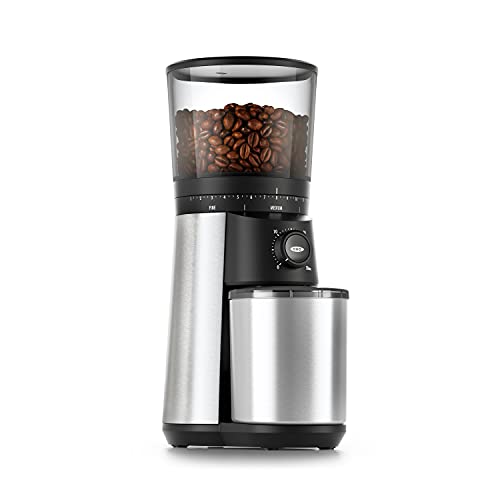
OXO's grinder is the one to buy if you want the problem solved rather than studied. The burrs are stainless conical, the adjustment ring offers micro-steps between its main positions, and the operation is a single button that remembers how long you ran it last time. For drip, pour-over, French press and cold brew, the grind it produces is close enough to the Encore's that most people would not reliably tell them apart in a cup.
It is also better presented than its rivals. The body is stainless rather than plastic, the hopper blocks UV to slow staling, and the grounds container is designed to reduce the static cling that makes cheap grinders spray coffee across a counter. It looks like a $200 appliance and costs considerably less, which is a substantial part of why it sells.
The compromises are structural rather than cosmetic. The adjustment steps are coarser than the Baratzas', which is invisible for filter brewing and disqualifying for espresso — this grinder reaches fine settings without offering enough of them to dial a shot. Dosing is timed, so it drifts as beans age and change density. And the drive train uses plastic gearing rather than the serviceable arrangement Baratza builds around, with parts support to match: this is a grinder to replace rather than repair. Judged on the next five years it is the best value here; judged on the next fifteen, the Encore is.
The best grinder most people can buy without thinking hard about it. It gets filter coffee right and stops short of the repairability that makes the Baratzas last.
Check price on Amazon →#4Best for espresso too
Breville Smart Grinder Pro BCG820BSS
Best for: Households that brew filter coffee and also pull espresso on a Breville machine
What we like
- 60 settings, the widest adjustment range in this roundup
- Grind time programmable in 0.2 second increments
- Grinds directly into a portafilter, container, gold filter or paper filter
- Stainless steel body with a clear LCD
- The natural pairing for a Breville machine without a built-in grinder
What we don't
- The 60 settings span the whole range, so no part of it is finely resolved
- Retention and static are noticeable, and worse with oily dark roasts
- Burrs and motor sit below the Baratzas' standard
- Times rather than weighs, with the usual drift
- Consumer-grade build with limited repair support
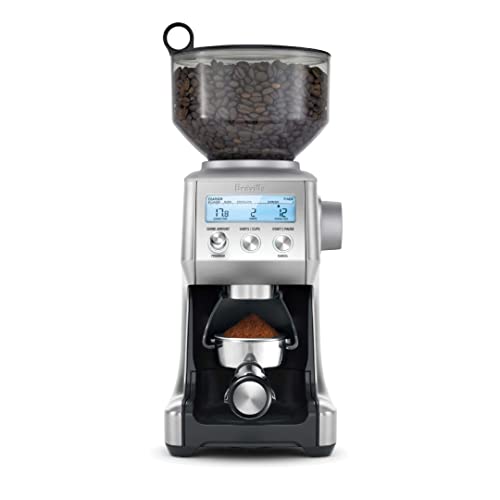
The Smart Grinder Pro's argument is coverage. Sixty settings, grind time programmable in fifth-of-a-second increments, and direct grinding into a portafilter, a sealed container, a gold basket or a paper filter mean it slots into almost any routine without adapters or workarounds. Paired with a Breville espresso machine that lacks a grinder it makes a complete setup, and it will handle the French press on Sunday just as readily.
What it does well is clear the bar in both directions at once. Most grinders at this price cannot make real espresso; this one can, and it still grinds coarse enough for cold brew. For a household that brews across methods, not having to own two grinders is a genuine benefit that specification comparisons tend to miss.
The cost of that coverage is that no part of the range is finely resolved. Sixty settings sound generous until you notice they are spread from espresso to French press, which leaves the espresso region with a fraction of them — fewer usable steps than the Encore ESP provides at a lower price. Retention and static are noticeable and get worse with oily dark roasts, the burrs and motor are a step below the Baratzas, and dosing is timed rather than weighed. Buy it for range, not for excellence at any one thing.
The most versatile grinder here and not the best at any single job. If you brew across methods including espresso, that versatility is the point.
Check price on Amazon →#5Best budget
Capresso Infinity Conical Burr Grinder
Best for: A first burr grinder on a tight budget, or a second grinder for decaf
What we like
- Solid steel conical burrs at a price where most rivals use inferior ones
- Gear-reduced motor runs slowly and is among the quietest here
- Sixteen settings across four labelled ranges, easy to understand
- Removable upper burr for cleaning
- Has been on sale essentially unchanged for two decades, which says something
What we don't
- Sixteen settings is genuinely few, and the steps are large
- Not usable for espresso in any serious sense
- Static cling sends grounds onto the counter
- All-plastic housing that looks and feels its price
- No timer, and no repair channel to speak of
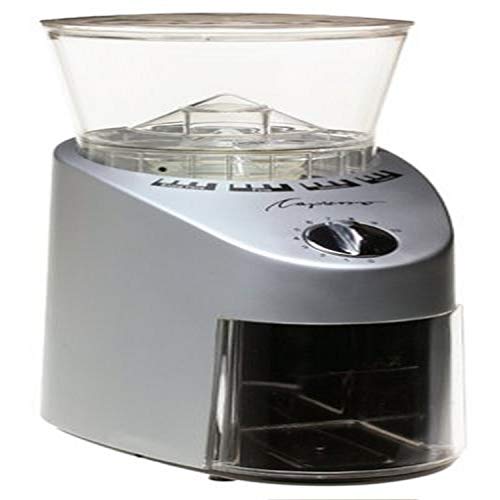
The Infinity has been sold in essentially its current form for around twenty years, which in a category full of annually refreshed models is a recommendation in itself. What keeps it alive is that it puts solid steel conical burrs and a slow gear-reduced motor into a grinder priced against machines that use neither. Slow grinding means less heat and less noise, and it is among the quietest grinders you can buy at any price.
For drip, French press and cold brew it does the job properly. The four labelled ranges — extra fine through coarse — with sixteen positions between them make it easy to use without understanding anything about grinders, which suits its role as a first purchase or a second unit kept loaded with decaf.
The limits arrive quickly if you push it. Sixteen settings is few, and each step is correspondingly large, so fine-tuning a pour-over recipe means choosing between two adjacent settings rather than landing between them. It cannot dial espresso in any meaningful way. Static is a real nuisance — grounds cling to the plastic bin and escape onto the counter — and the housing looks and feels like what it costs. There is no timer and effectively no repair path. Within those limits it is the honest budget answer, and a clear step above every blade grinder ever made.
The cheapest grinder here that is genuinely worth owning. It clears the bar that most budget grinders fail, and does nothing beyond that.
Check price on Amazon →Spend here before you spend on the brewer
A better dripper, kettle or press changes the coffee at the margins. A better grinder changes what the coffee can taste like at all, because it determines whether your particles extract at similar rates or at wildly different ones. The practical version of this advice: if you are choosing between upgrading your brewer and upgrading your grinder on the same budget, upgrade the grinder, and expect the difference to be more obvious than you were promised.
Repairability is a specification
Grinders are among the few objects in a kitchen with genuinely wearing parts — burrs dull, motors age, gearboxes fail. That makes a manufacturer’s parts channel a functional specification rather than a nicety. Baratza built its reputation as much on publishing repair guides and selling components for decade-old grinders as on the grinders themselves, and it is the main reason the Encore outranks cheaper machines that grind almost as well. A grinder you can rebuild for the price of a burr set is a different purchase from one that becomes rubbish when a gear strips.
Where filter and espresso requirements diverge
Everything on this page is judged for filter brewing, where useful adjustments are large and almost any burr grinder can find them. Espresso inverts that: the useful adjustments are tiny, and what matters is how many steps sit between a shot that runs fast and one that chokes. A grinder can be excellent here and nearly unusable there, which is why the best espresso grinders is a separate article with a different winner. If you want the underlying mechanics — conical versus flat, stepped versus stepless, why alignment matters more than burr size — burr grinders explained covers them. And if your budget is fixed and tight, the best budget grinders under $150 works through what you can give up without giving up the burrs.
Frequently asked questions
Is a burr grinder worth it over a blade grinder?
Yes, and it is the largest single improvement available to most home brewers. A blade grinder chops beans at random, producing dust and boulders at once; the dust over-extracts into bitterness while the boulders under-extract into sourness, in the same cup, and no brewing adjustment separates them. A burr grinder passes beans through a set gap, so size is chosen rather than left to chance. Even the cheapest competent burr grinder outperforms the most expensive blade grinder for this reason.
How much should I spend on a grinder for filter coffee?
Less than most enthusiast advice implies, because filter brewing tolerates a wider particle spread than espresso does. Somewhere around $100 buys a genuinely good filter grinder, and around $170 buys one you can repair for a decade. Above roughly $250 the gains for pour-over and drip become subtle and are mostly about speed, uniformity at the margins and build quality rather than a step change in the cup. If espresso is in your future, the calculation is different and the extra money goes into adjustment resolution instead.
Can I use these grinders for espresso?
Most of them, not usefully. Reaching espresso fineness is not the same as being able to steer at espresso fineness: what espresso needs is many small adjustment steps in the fine range, and grinders that spread their settings evenly across all brew methods leave only a few there. The Breville on this list is the most capable of the group and still constrained. If espresso matters to you, buy a grinder designed around that range rather than one that reaches it.
How often should I clean my grinder, and do I need to replace the burrs?
Brush out the grounds chamber and burr area every few weeks, more often with oily dark roasts, which leave residue that goes rancid and taints later brews. A deeper clean — removing the upper burr, which most grinders here allow — every few months keeps the adjustment mechanism moving freely. Burrs do wear, but slowly: home grinders typically go through many hundreds of kilograms before dullness becomes audible as slower grinding and a coarser result at the same setting. Manufacturers who sell replacement burrs make that a repair rather than a replacement.
Why do my grounds cling to everything?
Static, and it is worse in dry air, with light roasts, and with plastic collection bins. It is cosmetic rather than harmful, but it costs you grounds and makes a mess. The standard mitigation is the Ross Droplet Technique: stir a few drops of water into the beans before grinding, which dissipates the charge without meaningfully wetting the coffee. Metal or glass collection containers also help, which is part of why several grinders here advertise their bin material.
Should I buy a grinder with a built-in scale?
Only if the convenience is worth the premium to you, because a separate scale does the same job for a fraction of the cost and never becomes a reason to replace the grinder. Grinding by weight is genuinely better than grinding by time — timed dosing drifts as beans age and change density — but a $25 scale on the counter delivers that accuracy just as well as a built-in one. The built-in version buys you one fewer object and one fewer step, not better coffee.